Table of Contents 10 sections
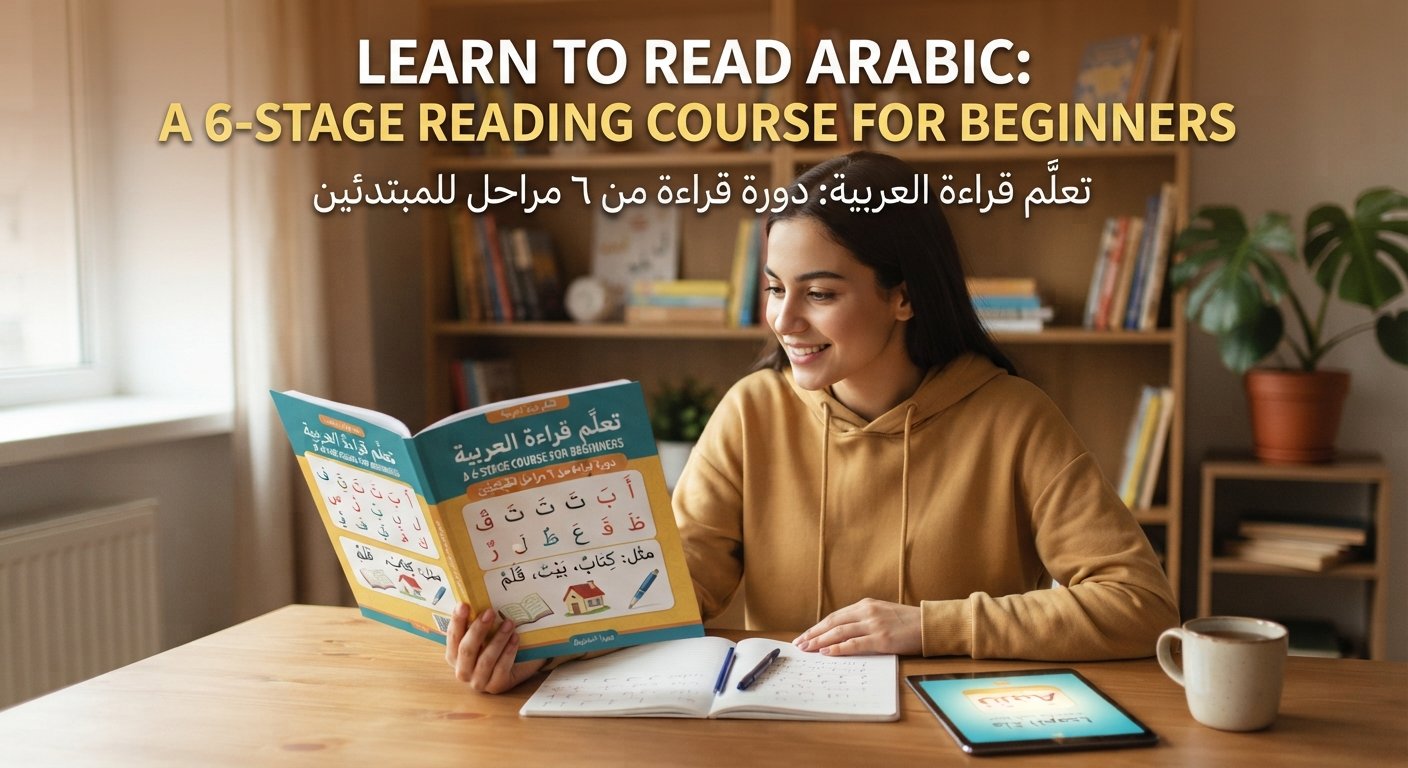
Most people learn the Arabic alphabet and then stall. The letters make sense, but real words and sentences still look like a wall of curves. That gap is not about talent: reading is its own skill, with its own steps. This course breaks it into six stages, each with a clear goal, practice material you can listen to, and a short self-check before you move on.
You will go from letter families to short vowelled words, the special marks found in almost every text, simple sentences, a short passage, and finally Arabic written without vowel marks, the way books, news and street signs actually look.
Stage 1Letter families
Many Arabic letters share one skeleton and differ only in the number and position of their dots. Learn the family first, then the dot pattern. It cuts the memory load roughly in half.
Stage 1 self-check
Stage 2Short vowelled words
Read each word right to left: say the first letter with its vowel mark, then glide into the next. Cover the transliteration, try it, then check. Press play to hear it.
| Word | Say it | Meaning | Listen |
|---|---|---|---|
| بَاب | bāb | door | |
| بَيْت | bayt | house | |
| كِتَاب | kitāb | book | |
| قَلَم | qalam | pen | |
| شَمْس | shams | sun | |
| قَمَر | qamar | moon | |
| مَاء | māʾ | water | |
| وَلَد | walad | boy | |
| بِنْت | bint | girl | |
| كَلْب | kalb | dog |
Notice بَاب: the alif after ب is a long vowel, so you stretch it. In بَيْت the little circle (sukūn) over ي means “no vowel here”, which gives the “ay” sound.
Stage 2 self-check
Stage 3Special marks and shapes
| Symbol | Name | What it does |
|---|---|---|
| ة | tāʾ marbūṭa | Ends many feminine words. Sounds like “-a” at the end of a word. |
| ـّـ | shadda | Doubles the letter it sits on, so you say it with extra weight. |
| ـً ـٌ ـٍ | tanwīn | Adds an “-n” ending (-an, -un, -in) to indefinite nouns. |
| لا | lām-alif | A fixed joined shape for ل followed by ا. It is two letters, not one. |
Try these three words, each with a different feature:
| Word | Say it | Meaning | Spot the feature | Listen |
|---|---|---|---|---|
| مَدْرَسَة | madrasa | school | tāʾ marbūṭa at the end | |
| سَيَّارَة | sayyāra | car | shadda on ي (doubled “yy”) | |
| شَجَرَة | shajara | tree | tāʾ marbūṭa again |
Stage 3 self-check
Stage 4Simple sentences
Read each sentence aloud first, then tap “Show meaning” to check yourself.
Show meaning
This is a big house.
Show meaning
This is a beautiful school. (هَذِهِ is “this” for feminine nouns; هَذَا is for masculine.)
Show meaning
The boy is in the garden. (الْ at the start means “the”.)
Show meaning
The book is on the table. (ط is a sun letter, so the ل of “al” is silent: “aṭ-ṭāwila”.)
Show meaning
I am a student. (A woman would say أَنَا طَالِبَةٌ.)
Show meaning
I like tea. (Notice the shadda on ب and ش: both are doubled.)
Stage 4 self-check
Stage 5A short passage
Here is a five-sentence passage with all vowel marks. Read it twice silently, then once aloud, then listen.
Show transliteration
ismī Sāra. anā ṭāliba fī l-madrasa. askunu fī baytin ṣaghīr. fī ṣ-ṣabāḥi ashrabu l-ḥalība thumma adhhabu ilā l-madrasa. uḥibbu l-qirāʾa.
Show translation
My name is Sara. I am a student at school. I live in a small house. In the morning I drink milk, then go to school. I love reading.
Check your understanding
1. What is the girl’s name?
Sara (سَارَة).
2. What kind of house does she live in?
A small house (بَيْتٍ صَغِيرٍ).
3. What does she drink in the morning?
Milk (الْحَلِيبَ).
Stage 5 self-check
Stage 6Reading without vowel marks
Books, news and signs usually drop the short-vowel marks. You supply them from your knowledge of the word. Here is the same passage, stripped of its marks:
Three habits that make unvowelled reading possible
- Read for the root. Spot the three core consonants of a word (for example ك ت ب = writing) and the vowels usually follow familiar patterns.
- Use the sentence. Context narrows the options: after “I” (أنا) you expect a verb or a description, not a random noun.
- Learn words as whole shapes. Common words like في, من and إلى become instantly recognisable, just like “the” and “of” in English.
Stage 6 self-check
PlanYour 6-week schedule
A realistic pace for most adults is 15–20 minutes a day, five days a week. Treat this as a starting point and adjust it to how you feel.
| Week | Focus | Daily routine |
|---|---|---|
| 1 | Stage 1: letter families | Review 2 families a day; write each letter three times. |
| 2 | Stage 2: short words | Read the ten words aloud; add two new words daily. |
| 3 | Stage 3: special marks | Find tāʾ marbūṭa and shadda in every text you see. |
| 4 | Stage 4: sentences | Read one sentence, cover it, then write it from memory. |
| 5 | Stage 5: passage | Read aloud daily; shadow the audio once. |
| 6 | Stage 6: no vowels, then review | Alternate vowelled and unvowelled reading of the same text. |
FAQFrequently asked questions
How long does it take to learn to read Arabic?
With 15–20 minutes a day, most learners read simple vowelled texts within about six weeks. Unvowelled texts such as news articles usually take several more months, because they need a wider vocabulary, not just better decoding.
Do I need to understand the words to practise reading?
Not at first. Stages 1–3 are about decoding, turning shapes into sounds. Meaning comes in strongly from Stage 4 onward, where every sentence is paired with a translation.
What if I get stuck on a stage?
Stay there. Moving on too early is the most common reason learners stall. Redo the self-check, and if one item still feels shaky, spend a few extra days on just that item.
Is the audio recorded by a native speaker?
The clips are computer-generated so you can hear each word and sentence right away. For fine pronunciation practice, pair them with a teacher or recordings by native speakers.
Should I learn to type Arabic too?
It helps once you recognise the letters, because typing reinforces spelling. Add an Arabic keyboard to your phone or computer around Stage 4.