Arabic verbs look intimidating in a phrasebook and completely logical once you see the machine underneath. Almost every verb in the language is built from a small, reusable set of moving parts — a root and a pattern — and once those two ideas click, conjugation stops being memorization and starts being assembly.
This guide walks through that system from the ground up: how roots work, how the two core tenses are built, full conjugation tables you can reference while you practice, and the ten verb “forms” that let a single root grow into a dozen related words.
فThe root: where every verb begins
Most Arabic verbs are built on a root of three consonants that carries a core meaning, independent of tense or subject. Grammar books represent this skeleton with the placeholder letters ف ع ل (fā’ – ‘ayn – lām), the Arabic equivalent of saying “verb” the way English textbooks say “do.”
Take the root ك ت ب (k-t-b), which carries the idea of writing. Slot those three consonants into different vowel-and-affix patterns, and the same root produces an entire family of related words:
| Arabic | Transliteration | What it means | Pattern role |
|---|---|---|---|
| كَتَبَ | kataba | he wrote | the verb itself |
| كِتَاب | kitāb | book | the written object |
| كَاتِب | kātib | writer | the person doing it |
| مَكْتَب | maktab | desk / office | the place it happens |
| مَكْتُوب | maktūb | written / a letter | the result of the action |
Same three consonants, five different words — the pattern around them does all the work.
عPast, present, and command
Arabic verbs conjugate across three main forms, and each one changes the root in a different way:
الماضي — the past
The past tense is built by adding suffixes to a fixed root shape. The subject is marked entirely at the end of the word, which is why كَتَبْتُ (I wrote) and كَتَبَتْ (she wrote) share the same opening shape but end differently.
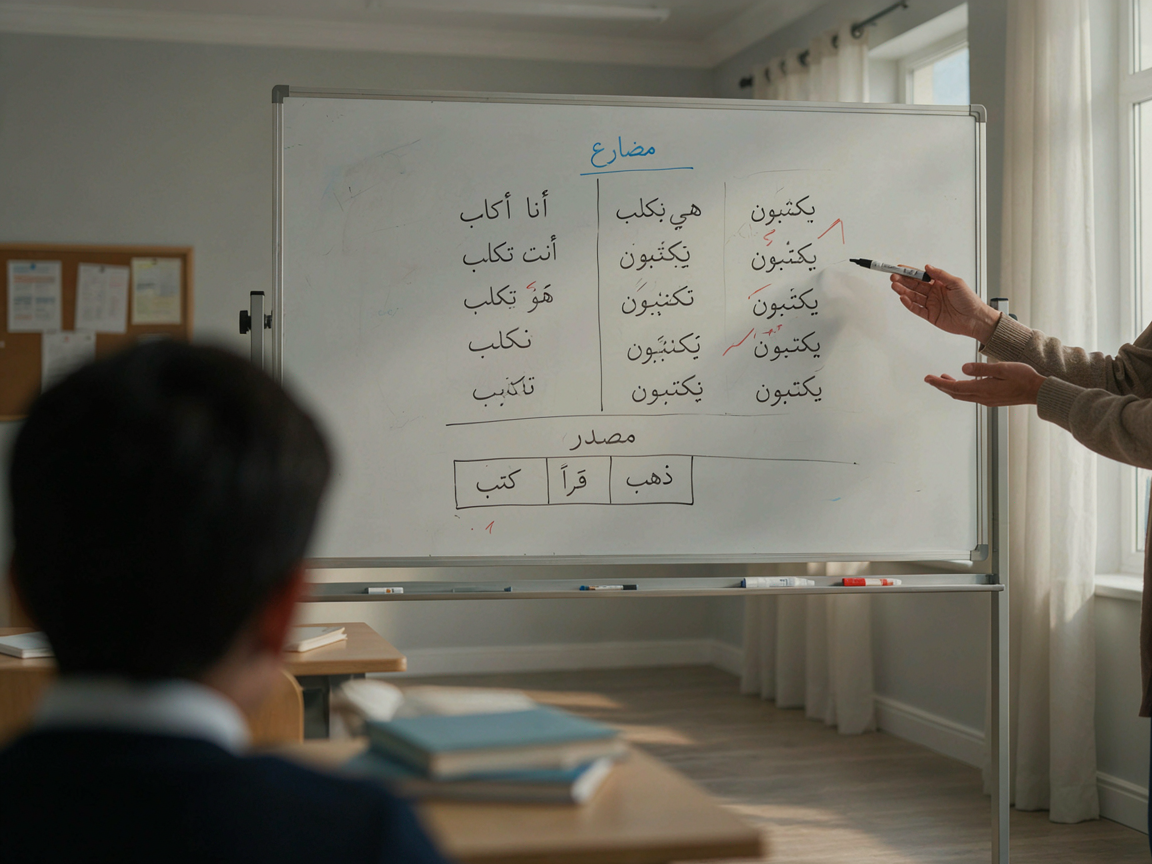
المضارع — the present
The present tense flips the strategy: it’s built with prefixes (and sometimes suffixes too) attached to a slightly different root shape. The prefix alone tells you who the subject is before you’ve even reached the root letters — أ for “I,” ت for “you” or “she,” ي for “he” or “they,” ن for “we.”
الأمر — the command
The imperative is essentially a stripped-down present tense: drop the subject prefix, adjust the ending, and you have a direct command form — used only for “you,” since you can’t order yourself or someone absent to do something.
لFull past-tense table: كَتَبَ (to write)
| Pronoun | Arabic | Transliteration | Meaning |
|---|---|---|---|
| أنا (I) | كَتَبْتُ | katabtu | I wrote |
| أنتَ (you, m.) | كَتَبْتَ | katabta | you wrote |
| أنتِ (you, f.) | كَتَبْتِ | katabti | you wrote |
| هو (he) | كَتَبَ | kataba | he wrote |
| هي (she) | كَتَبَتْ | katabat | she wrote |
| نحن (we) | كَتَبْنَا | katabnā | we wrote |
| أنتم (you, m.pl.) | كَتَبْتُمْ | katabtum | you all wrote |
| أنتنّ (you, f.pl.) | كَتَبْتُنَّ | katabtunna | you all wrote |
| هم (they, m.) | كَتَبُوا | katabū | they wrote |
| هنّ (they, f.) | كَتَبْنَ | katabna | they wrote |
Formal Arabic also has dual forms (for exactly two people) — worth learning once singular and plural feel automatic.
يFull present-tense table: يَكْتُبُ (to write)
| Pronoun | Arabic | Transliteration | Meaning |
|---|---|---|---|
| أنا (I) | أَكْتُبُ | aktubu | I write |
| أنتَ (you, m.) | تَكْتُبُ | taktubu | you write |
| أنتِ (you, f.) | تَكْتُبِينَ | taktubīna | you write |
| هو (he) | يَكْتُبُ | yaktubu | he writes |
| هي (she) | تَكْتُبُ | taktubu | she writes |
| نحن (we) | نَكْتُبُ | naktubu | we write |
| أنتم (you, m.pl.) | تَكْتُبُونَ | taktubūna | you all write |
| هم (they, m.) | يَكْتُبُونَ | yaktubūna | they write |
| هنّ (they, f.) | يَكْتُبْنَ | yaktubna | they write |
Notice that “you (m.)” and “she” share the exact same form, تَكْتُبُ — context and the surrounding sentence carry the difference.
صSound roots vs. weak roots
Everything above uses a sound root — three ordinary consonants that never disappear or shift. Not every root is that cooperative. Roots that contain و, ي, or a doubled letter behave differently, and grammar books group them by where the irregularity sits:
- Weak roots (معتلّ): contain و or ي as one of the three consonants, which tends to contract or vanish depending on position — e.g. the root behind قَالَ (qāla, “he said”) is ق و ل.
- Doubled roots (مضعّف): the second and third consonants are identical and often merge, as in مَدَّ (madda, “he extended”), from the root م د د.
- Hamzated roots (مهموز): contain a glottal stop (ء) that shifts its written form depending on the surrounding vowels, as in سَأَلَ (sa’ala, “he asked”).
The good news: these irregularities follow their own predictable rules — they’re not random exceptions, just a second layer of pattern to learn after sound roots feel automatic.
وThe ten verb forms (الأوزان)
A single root doesn’t just conjugate — it can be reshaped into ten recognized “forms,” each adding a consistent shade of meaning: causing, trying, doing to each other, and so on. Learn the ten shapes once, in the abstract, and you can recognize what any new verb is doing the moment you see its skeleton.
| Form | Pattern | Typical meaning shift | Example |
|---|---|---|---|
| I | فَعَلَ | the base action | كَتَبَ — he wrote |
| II | فَعَّلَ | causative / intensive | دَرَّسَ — he taught |
| III | فَاعَلَ | doing it toward someone | كَاتَبَ — he corresponded with |
| IV | أَفْعَلَ | causative | أَخْرَجَ — he took (something) out |
| V | تَفَعَّلَ | reflexive of II | تَعَلَّمَ — he learned |
| VI | تَفَاعَلَ | doing it to each other | تَعَاوَنَ — he cooperated |
| VII | اِنْفَعَلَ | passive / happening on its own | اِنْكَسَرَ — it broke |
| VIII | اِفْتَعَلَ | reflexive, self-involved | اِجْتَمَعَ — he gathered (with others) |
| IX | اِفْعَلَّ | colors and physical traits | اِحْمَرَّ — he/it turned red |
| X | اِسْتَفْعَلَ | seeking / requesting | اِسْتَخْرَجَ — he extracted |
Forms II, III, V, VI, and X aren’t used for every root — but when they exist, the meaning shift above is dependable.
مHow to actually practice this
- Drill one root through every pronoun before moving to the next root — depth first, breadth later.
- Say the pronoun out loud before the verb so your ear starts predicting the prefix or suffix automatically.
- Write, don’t just read. Conjugation is a motor pattern as much as a memory one; your hand needs the reps too.
- Learn forms II, III, and X early — after form I, these three cover a large share of everyday vocabulary.
- Keep a running list of weak-root exceptions as you meet them, instead of trying to front-load every irregularity at once.
؟Frequently asked questions
Do I need to memorize every single verb form?
No. Form I (the base) and forms II, III, V, VII, VIII, and X cover the vast majority of verbs you’ll actually encounter. Learn to recognize all ten patterns by sight before you worry about producing every one from memory.
What’s the real difference between المضارع and الأمر?
The imperative is essentially the present tense with the subject prefix removed and the ending adjusted — it only exists for commands directed at “you,” since you can’t command yourself or someone not being addressed.
Are irregular (weak) verbs common in everyday Arabic?
Very common — many high-frequency verbs like “to say,” “to be,” and “to want” are weak roots. That’s exactly why it’s worth learning the sound-root system solidly first: it becomes the baseline you compare every irregularity against.
How long does conjugation typically take to feel automatic?
With regular practice, most learners get comfortable producing past and present tense for sound roots within a few weeks. The ten verb forms and weak-root patterns usually take longer, since they build on that base rather than replacing it.
Does Modern Standard Arabic conjugation match spoken dialects?
The underlying root-and-pattern logic carries over, but dialects simplify or drop several MSA endings (like most case and mood markers). Learning MSA conjugation first gives you the skeleton that every dialect then adapts.
You might also like