Table of Contents 11 sections
Arabic verbs can look like a wall of unfamiliar letters until you notice the small machine underneath. Most of the time, a root carries the central idea and a pattern tells you how that idea is being used. Once you can see those two layers, conjugation feels much less like collecting random forms and much more like putting familiar pieces together.
This guide starts with the root-and-pattern system, then shows how a regular verb behaves in the past, present, and imperative. The tables use كَتَبَ (to write), so you can focus on the endings and prefixes instead of learning new vocabulary at the same time.
The root: where every verb begins
Many Arabic words are built around a root of three consonants. The root is not a complete word by itself; it is a compact bundle of meaning that can be placed inside different patterns. Traditional grammar books use ف ع ل (fāʾ, ʿayn, lām) as the three placeholder letters, much like English grammar books use “X” in a formula.
The root ك ت ب (k-t-b), for example, is connected with writing. Change the vowels and add the right letters around it, and you get a small family of related words:
| Arabic | Transliteration | What it means | Pattern role |
|---|---|---|---|
| كَتَبَ | kataba | he wrote | the basic verb |
| كِتَاب | kitāb | book | the written object |
| كَاتِب | kātib | writer | the person doing it |
| مَكْتَب | maktab | desk or office | the place associated with it |
| مَكْتُوب | maktūb | written or a letter | the result of the action |
The root gives you the family resemblance. The pattern supplies the particular meaning and grammatical role.
Past, present, and command
For a regular verb, the past and present are built in noticeably different ways. Learning that contrast is one of the first moments when Arabic conjugation starts to feel predictable.
الماضي — the past
The past tense usually starts with a stable verb shape and adds endings for the subject. Compare كَتَبْتُ (I wrote) with كَتَبَتْ (she wrote): the beginning stays familiar, while the ending tells you who did the action.
المضارع — the present
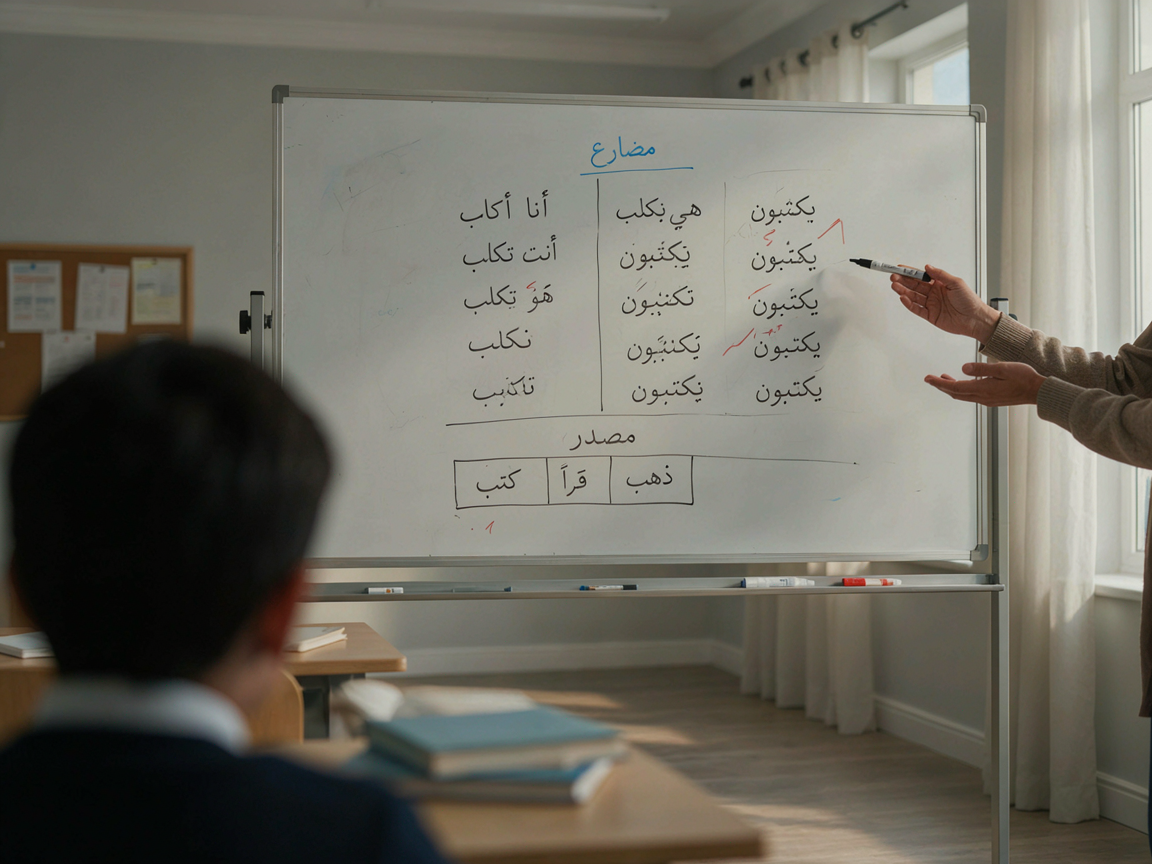
The imperfect, commonly used for present and ongoing actions, uses one of four prefixes: أ for “I,” ت for “you” or “she,” ي for “he” or “they,” and ن for “we.” Some subjects also take a special ending.
الأمر — the command
The imperative is used with the second person, meaning the person being addressed. It is related to the present form, but the prefix is removed and the vowels or ending may change. For example, تَكْتُبُ becomes اُكْتُبْ (write!).
Past-tense table: كَتَبَ (to write)
| Pronoun | Arabic | Transliteration | Meaning |
|---|---|---|---|
| هو (he) | كَتَبَ | kataba | he wrote |
| هما (they two, m.) | كَتَبَا | katabā | they two wrote |
| هم (they, m.) | كَتَبُوا | katabū | they wrote |
| هي (she) | كَتَبَتْ | katabat | she wrote |
| هما (they two, f.) | كَتَبَتَا | katabatā | they two wrote |
| هنّ (they, f.) | كَتَبْنَ | katabna | they wrote |
| أنتَ (you, m.) | كَتَبْتَ | katabta | you wrote |
| أنتما (you two, m.) | كَتَبْتُمَا | katabtumā | you two wrote |
| أنتم (you, m.pl.) | كَتَبْتُمْ | katabtum | you all wrote |
| أنتِ (you, f.) | كَتَبْتِ | katabti | you wrote |
| أنتما (you two, f.) | كَتَبْتُمَا | katabtumā | you two wrote |
| أنتنّ (you, f.pl.) | كَتَبْتُنَّ | katabtunna | you all wrote |
| أنا (I) | كَتَبْتُ | katabtu | I wrote |
| نحن (we) | كَتَبْنَا | katabnā | we wrote |
The two dual “you” rows use the same verb form in Arabic. They are shown separately because the pronouns are conventionally taught as masculine and feminine entries.
Present-tense table: يَكْتُبُ (to write)
| Pronoun | Arabic | Transliteration | Meaning |
|---|---|---|---|
| هو (he) | يَكْتُبُ | yaktubu | he writes |
| هما (they two, m.) | يَكْتُبَانِ | yaktubāni | they two write |
| هم (they, m.) | يَكْتُبُونَ | yaktubūna | they write |
| هي (she) | تَكْتُبُ | taktubu | she writes |
| هما (they two, f.) | تَكْتُبَانِ | taktubāni | they two write |
| هنّ (they, f.) | يَكْتُبْنَ | yaktubna | they write |
| أنتَ (you, m.) | تَكْتُبُ | taktubu | you write |
| أنتما (you two, m.) | تَكْتُبَانِ | taktubāni | you two write |
| أنتم (you, m.pl.) | تَكْتُبُونَ | taktubūna | you all write |
| أنتِ (you, f.) | تَكْتُبِينَ | taktubīna | you write |
| أنتما (you two, f.) | تَكْتُبَانِ | taktubāni | you two write |
| أنتنّ (you, f.pl.) | تَكْتُبْنَ | taktubna | you all write |
| أنا (I) | أَكْتُبُ | aktubu | I write |
| نحن (we) | نَكْتُبُ | naktubu | we write |
The form تَكْتُبُ can mean “you write” to a man or “she writes.” The surrounding pronoun and sentence make the difference clear.
Sound roots vs. weak roots
كَتَبَ is a sound root: its three consonants remain easy to see throughout the basic forms. Other roots contain letters that change, disappear, or merge in certain environments. These are not broken verbs; they are regular members of different verb classes.
- Weak roots (معتلّ): contain و or ي as a root consonant. The root ق و ل gives قَالَ (qāla, “he said”), where the written shape does not show the original و directly.
- Doubled roots (مضعّف): have the same second and third consonant, which often appears as a shadda. مَدَّ (madda, “he extended”) comes from م د د.
- Hamzated roots (مهموز): contain ء. Its written seat can change according to the surrounding vowels, as in سَأَلَ (saʾala, “he asked”).
Start with sound roots, but do not wait for every irregular verb to become easy before reading real Arabic. High-frequency weak verbs appear early and often, so learn each one as its own useful pattern.
The ten verb forms (الأوزان)
Verb forms are patterns built from the same three root consonants. They often add a predictable shade of meaning, but the shade is a tendency rather than a promise. A dictionary and a few real examples are still necessary.
| Form | Pattern | Common tendency | Example |
|---|---|---|---|
| I | فَعَلَ | the basic action | كَتَبَ — he wrote |
| II | فَعَّلَ | intensive, causative, or transitive | دَرَّسَ — he taught |
| III | فَاعَلَ | interaction or action toward another | كَاتَبَ — he corresponded with |
| IV | أَفْعَلَ | causing or making something happen | أَخْرَجَ — he took something out |
| V | تَفَعَّلَ | often the reflexive or intransitive partner of II | تَعَلَّمَ — he learned |
| VI | تَفَاعَلَ | reciprocal or mutual action | تَعَاوَنَ — he cooperated |
| VII | اِنْفَعَلَ | often passive or an action happening to the subject | اِنْكَسَرَ — it broke |
| VIII | اِفْتَعَلَ | often reflexive, effortful, or associative | اِجْتَمَعَ — he gathered |
| IX | اِفْعَلَّ | colors and physical qualities | اِحْمَرَّ — it turned red |
| X | اِسْتَفْعَلَ | seeking, requesting, or considering | اِسْتَخْرَجَ — he extracted |
Not every root appears in every form, and a form’s meaning depends on the individual verb. Treat these patterns as clues that help you make a strong first guess.
How to practise without getting lost
- Stay with one root for a few days. Move it through the pronouns before jumping to another root. Repeated shapes are easier to remember when they stay connected.
- Say the pronoun first. “I — أَكْتُبُ” and “she — تَكْتُبُ” make the ending or prefix meaningful instead of abstract.
- Write and speak together. Your hand notices small spelling changes while your ear learns to expect them.
- Use short sentences early. A form becomes useful when it describes something real: أَكْتُبُ رِسَالَةً (I am writing a message).
- Keep a small irregular-verb notebook. Record the root, one example sentence, and the form that surprised you. That is more useful than trying to memorize every exception in advance.
Frequently asked questions
Do I need to memorize all ten verb forms immediately?
No. Begin by recognizing Form I, then add the forms that appear in the vocabulary you are actually reading. Recognition usually comes before confident production.
Why are some dual entries repeated in the tables?
Arabic distinguishes masculine and feminine pronouns even when the verb itself has the same form. Showing both entries makes the complete pronoun system visible instead of hiding an important part of it.
Is the present tense only used for actions happening now?
No. In Modern Standard Arabic, the imperfect can describe present, habitual, or future actions. Context, time words, and particles such as سـ help establish the intended time.
Are weak verbs common in everyday Arabic?
Very common. Verbs such as “to say,” “to be,” and “to want” belong to irregular classes. That is why the sound-root system is a starting point, not the whole language.
Does Modern Standard Arabic conjugation match dialects?
The root-and-pattern idea carries over, but dialects often reduce endings, change vowels, and use different everyday verbs. Learning MSA gives you a useful framework; listening to the target dialect teaches you how that framework sounds in real conversation.