Arabic Alphabet Workbook for Kids: 28 Letters in 4 Weeks
As an Amazon Associate I earn from qualifying purchases.
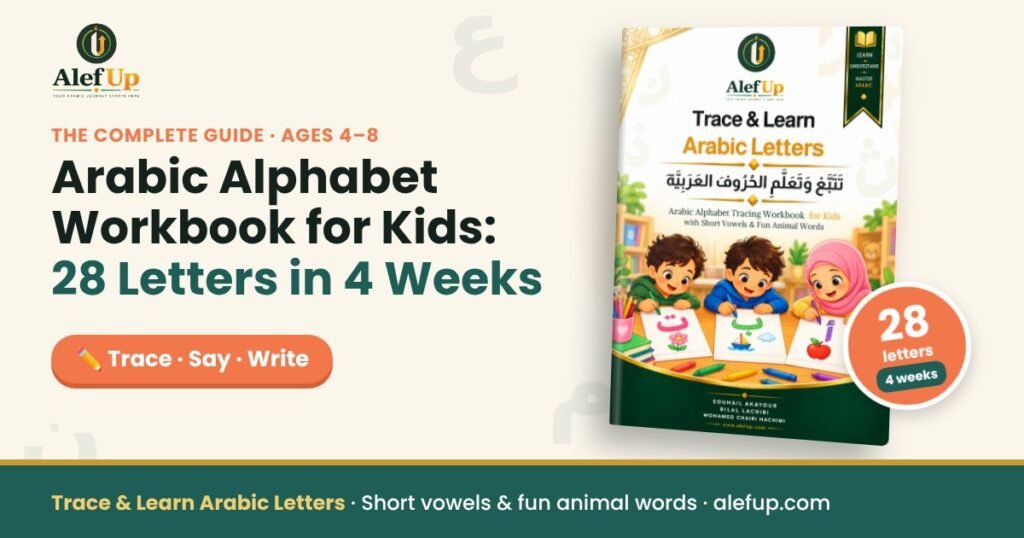
Table of Contents 20 sections
Quick Summary
If you are searching for an Arabic alphabet workbook for kids that is simple, colorful and genuinely fun, Trace & Learn Arabic Letters was built for exactly that job. This large A4 paperback guides children ages 4 to 8 through all 28 letters of the Arabic alphabet, one letter per page. On every page, your child traces the letter with the four short vowel marks (fatha, kasra, damma and sukun) and meets a friendly animal whose Arabic name starts with that letter, from Arnab (rabbit) to Yamama (dove).
In short, this workbook turns a brand-new alphabet into a daily, five-minute adventure. It works for bilingual families, homeschoolers, weekend and Islamic schools, and parents who do not speak Arabic themselves, because every letter comes with its English name and easy pronunciation. If you want your child to recognize, say and write every Arabic letter with confidence, this is the book we designed to make that happen.
What Is Trace & Learn Arabic Letters?
Trace & Learn Arabic Letters is an Arabic alphabet workbook for kids ages 4 to 8. Three teachers from AlefUp, Souhail Akayour, Bilal Lachiri and Mohamed Chairi Hachimi, created it to give young children a joyful first contact with Arabic writing.
The idea is simple. Instead of overwhelming a child with grammar or long explanations, the book focuses on one clear goal: learning to recognize and write the 28 Arabic letters.
Each letter gets its own full page. As a result, children never feel rushed. They see the letter, hear its name, trace it, and then connect it to a word they will remember.
The book belongs to our AlefUp Kids series. Our other titles, Arabic Verb Patterns and The Arabic Alphabet, serve teens and adults. With this workbook, we wanted the youngest learners to have a strong, happy start.
Key facts at a glance:
Who Is This Arabic Alphabet Workbook for Kids Made For?
First and foremost, we made this workbook for young beginners. A child who has never written a single Arabic letter can open page one and start right away.
However, the book serves several groups of families and teachers in the USA.
Bilingual and heritage families. Many parents speak Arabic at home but want their children to read and write it too. This workbook gives them a structured tool, so Arabic does not stay only a spoken language.
Families who don’t speak Arabic. Some parents want their kids to learn Arabic for faith, culture or simply a love of languages. Because every letter includes its English name and pronunciation, these parents can sit next to their child and learn together.
Homeschoolers. Homeschool parents love materials that need little preparation. Here, each page is a ready-made lesson. Open the book, pick up a pencil, and you are done in ten minutes.
Weekend schools and Islamic schools. Teachers can use one page per class, send pages home as practice, or use the book as a full first-term curriculum for the alphabet.
Kids preparing to read the Quran. Reading the Quran starts with recognizing letters and vowel marks. Consequently, this workbook builds exactly the foundation those children need.
What’s Inside the Book: A Page-by-Page Tour
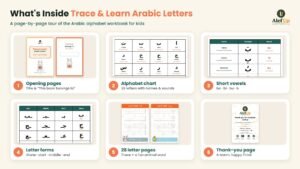
Let’s open the book together. Here is what your child will find, in order.
The opening pages
The book opens with a friendly title page and a “This book belongs to” page. Kids love writing their own name on it, and that small detail makes the book feel personal from minute one.
Next, a short page for parents and teachers explains how to use the book: one letter a day, say it first, trace slowly, and celebrate progress.
The Arabic alphabet chart
Then comes a clear chart with all 28 letters in order, read from right to left. Each letter includes its English name and a simple pronunciation hint, such as “b as in ball” or “s as in sun.” For parents who don’t read Arabic, this page is a lifesaver.
The short vowels
After that, a simple page introduces the four short vowels using the letter Baa as an example: ba, bi, bu and b. Children see the small marks above and below the letter and hear how each one changes the sound.
The forms of the letters
Arabic letters change shape depending on where they appear in a word. Therefore, the book includes a gentle introduction to the alone, start, middle and end forms, with clear examples. Kids learn early that a letter “holds hands” with its neighbors.
The 28 letter pages
This is the heart of the workbook. Each letter gets a full page with:
– The letter shown big and clear
– Tracing lines with the four short vowels
– A fun animal whose Arabic name starts with that letter
– The animal’s name in Arabic, with easy pronunciation
The thank-you page
Finally, the book closes with a warm thank-you message. Small touch, big smile.
Why Tracing Works So Well for Young Learners
A 2025 study reported by Neuroscience News found that children aged 5 to 6 learned letters better by writing them by hand than by typing, and those who moved on to writing freely did best. That’s why we see tracing as the first step: once the hand knows the path, encourage your child to write each letter on their own.
You might wonder why we built the whole book around tracing. The answer comes from how young children learn to write.
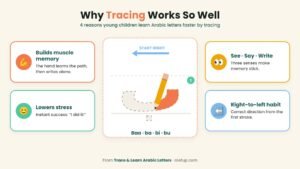
Tracing builds muscle memory. When a child follows the same path with a pencil again and again, the hand learns the movement. Later, the child can write the letter without a guide.
Tracing also lowers stress. A blank page can scare a four-year-old. A traced letter, on the other hand, gives instant success. That feeling of “I did it!” keeps kids coming back the next day.
Moreover, tracing connects three skills at once.
As education experts explain in The 74, handwriting engages several senses at once, and once letter formation becomes automatic, children can focus on reading and bigger ideas.
The child sees the letter, says its name out loud, and writes it with the hand. This multisensory approach helps memory stick much better than looking alone.
For Arabic specifically, tracing solves a big challenge. Arabic is written from right to left, and many strokes move in directions English-speaking kids are not used to. Tracing guides their hand in the correct direction from the very first stroke, so bad habits never form.
The Four Short Vowels, Made Simple
Many alphabet books stop at the letters. However, Arabic letters alone are not enough to read real words. Children also need the short vowels, the little marks that tell you how to pronounce each letter.
That’s why every tracing page in Trace & Learn Arabic Letters includes the four short vowels:
– Fatha: a small line above the letter, sounds like “a” in cat
– Kasra: a small line below the letter, sounds like “i” in sit
– Damma: a little waw above the letter, sounds like “u” in put
– Sukun: a small circle above the letter, meaning no vowel
By tracing each letter with all four marks, children learn something powerful: one letter can make several sounds. For example, Baa becomes ba, bi, bu or b.
This repetition is the secret to early reading. After a few weeks, children start to read simple syllables on their own. As a result, the jump from letters to real words feels natural instead of scary.
Fun Animal Words: Vocabulary From Day One
Kids remember stories and pictures far better than abstract symbols. So we paired every letter with an animal.
The book starts with Arnab, the rabbit, for the letter Alif, and ends with Yamama, the dove, for the letter Yaa. In between, each letter introduces a new animal friend.
Each animal word includes:
– The Arabic word, written clearly
– An easy pronunciation guide in English letters
– The English meaning
This approach has two big benefits. First, the animal acts as a memory hook. When a child forgets a letter, remembering “Arnab” brings the letter Alif right back.
Second, children finish the book with 28 real Arabic words already in their vocabulary. In other words, they don’t just learn letters; they start speaking Arabic, too.
How to Use the Workbook at Home (A 4-Week Plan)
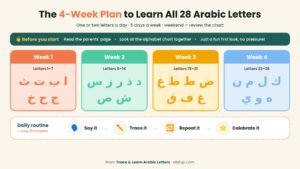
The best part about this Arabic alphabet workbook for kids is how easy it is to turn into a daily habit. Here is a simple plan that fits busy American family schedules.
Before you start
Read the parents’ page and look at the alphabet chart together. Point to each letter and say its name. Don’t expect your child to remember everything; this is just a fun first look.
Daily routine (10 minutes)
1. Say it. Read the letter name and the animal name out loud together.
2. Trace it. Trace the letter slowly with each short vowel, starting from the right.
3. Repeat it. Say ba, bi, bu, b (or the matching sounds for that letter).
4. Celebrate it. Add a sticker or a star when the page is done.
Week 1: Letters 1 to 7
Week 2: Letters 8 to 14
Week 3: Letters 15 to 21
Week 4: Letters 22 to 28
Five days a week, one or two letters a day, and your child finishes the whole alphabet in about a month. On the weekend, go back to the chart and review.
Tips that really help
– Use a pencil, not a pen. Mistakes are part of learning.
– Keep sessions short. Stop while your child is still having fun.
– Praise effort, not perfection. Wobbly letters are progress.
– Make it a ritual. The same time every day, for example after dinner, builds a habit fast.
Using It in Classrooms, Weekend Schools and Islamic Schools
Teachers in weekend and Islamic schools often face the same problem. They have little class time, mixed ages, and students who don’t practice at home.
This workbook helps with all three.
Little class time. Each page takes ten to fifteen minutes. Therefore, a teacher can cover one letter at the start of every class and still have time for Quran, stories or games.
Mixed ages. Younger kids focus on tracing. Older kids can say the vowels, read the animal word and try writing the letter without the guide.
No practice at home. Because the book is clear and self-explanatory, parents can continue the work at home even if they don’t read Arabic.
Some teachers ask each family to buy a copy, so every child has a personal workbook. Others use it as a weekly homework book. Either way, the clear structure makes planning easy.
Can Parents Who Don’t Speak Arabic Use It?
Absolutely, and this was one of our main goals.
Every instruction in the book is in simple English. Moreover, the alphabet chart gives each letter’s English name and a sound you already know, like “m as in moon.”
The animal words also include pronunciation in English letters. So even if you have never studied Arabic, you can read “Arnab” out loud and say it correctly.
A few Arabic sounds have no exact English match, such as the deep Ayn or the heavy letters. For those, the book gives a simple description, and you can always look up a short audio clip online if you want to hear it. Kids usually pick these sounds up faster than adults do.
In fact, many parents tell us they learn the alphabet alongside their children. That shared learning time becomes one of the best parts of the day.
Print Quality, Size and Format
We chose a large A4 format, 8.27 x 11.69 inches, on purpose. Young children need space. Big letters and wide tracing lines make it much easier for small hands to control a pencil.
The book is printed in full color, so every page feels bright and inviting. The animals, the frames and the colorful details keep kids engaged page after page.
It is a paperback, which keeps it light and easy to carry to school or on a trip. Since it is a workbook, children write directly on the pages, so you may want one copy per child.
Tip: If you have two children, buy two copies. Kids love having “their” book with their own name on the first page.
Why Arabic Feels Hard for American Kids (and How This Book Helps)
The Arabic alphabet has 28 letters and is written from right to left, which is exactly why early tracing practice makes such a difference.
For a child raised with English, Arabic brings a few surprises. Understanding them helps you support your child with patience.
It reads from right to left. English-speaking kids are trained to start on the left. At first, their hand naturally wants to go the wrong way. That’s why the tracing lines in this book matter so much: they guide the pencil from right to left until the movement feels normal.
Letters connect. In English, printed letters stand apart. In Arabic, most letters join their neighbors and change shape a little. The book introduces this idea gently, with a simple “letters hold hands” explanation and clear examples, so it never feels confusing.
Dots make a big difference. Several Arabic letters share the same basic shape and differ only by their dots, like Baa, Taa and Thaa. Tracing each one on its own page helps children notice the dots and remember where they go.
Some sounds are new. A few Arabic sounds don’t exist in English. Instead of turning these into a lesson in phonetics, the book gives short, friendly hints like “deep k” or “breathy h.” Young children copy sounds naturally, so a little listening and repetition goes a long way.
Vowels are tiny marks. In English, vowels are full letters. In Arabic, short vowels are small marks above or below the letter. By tracing every letter with all four marks, kids get used to looking for them, which is a key skill for reading later.
The good news? Children adapt much faster than adults. With short daily practice, what looked strange in week one feels completely natural by week four.
7 Ways to Keep Your Child Motivated
Even the best Arabic alphabet workbook for kids only works if your child keeps opening it. Here are seven simple ideas that families and teachers use to keep the excitement alive.
1. Use a sticker chart. Put a small chart on the fridge with 28 boxes. Every finished letter earns a sticker. Kids love watching the chart fill up.
2. Turn animals into a game. After a few pages, ask, “Which letter does Arnab start with?” Guessing games make review feel like play.
3. Make letter hunts. Show your child Arabic letters on food packages, books or signs, and ask them to find the letters they already know.
4. Let your child teach you. Ask your child to explain a page to you or to a grandparent. Teaching someone else builds pride and memory.
5. Keep a “best letter” page. Each week, let your child choose the letter they wrote best and show it to the family.
6. Mix in movement. Draw big letters in the air, in sand, or with a finger on your child’s back, then go back to the page.
7. Celebrate the finish line. When all 28 letters are done, celebrate with a small party, a certificate or a favorite treat. Finishing a whole alphabet is a real achievement.
What Comes After This Workbook?
Once your child knows all 28 letters and the short vowels, the next steps become much easier.
First, keep reviewing. Go back to the alphabet chart once or twice a week so the letters stay fresh.
Next, move to simple syllables and short words. Because your child already reads ba, bi and bu, combining two or three letters into a word feels like a small, natural step.
After that, introduce the long vowels, Alif, Waw and Yaa, which stretch sounds. Then practice reading short words and simple sentences.
At AlefUp, we publish free lessons and guides on our website to help families continue the journey. Our goal is simple: take your child from the first traced letter all the way to confident reading.
Pros and Cons
Pros
– Covers all 28 Arabic letters, one full page each
– Includes the four short vowels on every letter page
– A fun animal word for every letter, with pronunciation
– English names and sound hints make it easy for non-Arabic-speaking parents
– Large A4 size, ideal for small hands
– Full-color, kid-friendly design
– Short daily lessons that fit busy family life
– Great for homeschool, weekend school and Islamic school
– Written by experienced Arabic teachers
Cons
– Paperback only, so children write directly in the book (one copy per child)
– Focuses on letters and short vowels; long vowels and full words come in later levels
– No audio included, so a few sounds need a quick online listen
Honestly, these cons are part of the design. We kept the book focused so young children can master the basics before moving on.
How It Compares to Other Arabic Workbooks for Kids
The market offers many Arabic alphabet books. So what makes this one different?
Many books show only the letters. This one adds short vowels to every page, which prepares kids for real reading.
Some books are fully in Arabic, which leaves non-Arabic-speaking parents behind. This one explains everything in clear English.
Other books cram several letters onto one page. Here, each letter gets a full page, so the child never feels overwhelmed.
Finally, many workbooks feel like school exercises. Our animal words, bright colors and friendly design make learning feel like play.
In short, if you want one Arabic alphabet workbook for kids that balances tracing, vowels, vocabulary and fun, this book covers all four in one place.
Your Child’s First Step Into Arabic Starts Here
Learning a new alphabet can feel like a giant mountain for a small child. Trace & Learn Arabic Letters turns that mountain into 28 small, happy steps.
Each page gives your child a clear goal, a quick success and a new animal friend. Day by day, letter by letter, Arabic stops being strange and starts feeling familiar.
For parents, the book removes the guesswork. You don’t need a teaching degree, and you don’t even need to speak Arabic. Simply open the next page and follow the routine.
For teachers, it offers a ready-made, well-structured tool that saves planning time and keeps students engaged.
So, if you’ve been looking for the right Arabic alphabet workbook for kids, we truly believe this is a wonderful place to start. Grab a pencil, pick a cozy corner, and let the adventure begin.
FAQs about arabic alphabet workbook for kids
What is the best Arabic alphabet workbook for kids?
The best workbook is one your child enjoys using every day. Trace & Learn Arabic Letters is designed for ages 4 to 8 and combines tracing, short vowels and fun animal words on one page per letter, which makes it a strong choice for beginners.
What age is Trace & Learn Arabic Letters for?
It is made for children ages 4 to 8. Younger kids focus on tracing, while older kids can also read the vowel sounds and the animal words.
Can my child use this workbook if we don’t speak Arabic at home?
Yes. All instructions are in English, and every letter includes its English name and an easy pronunciation guide, so parents can learn alongside their children.
Does the workbook teach the Arabic short vowels?
Yes. Every letter page includes tracing with the four short vowels: fatha, kasra, damma and sukun. The book also has a simple introduction page that explains them.
How long does it take to finish the book?
With one letter a day, five days a week, most children finish all 28 letters in about four to six weeks.
Is this workbook good for Islamic school or Quran preparation?
Yes. Recognizing letters and vowel marks is the first step toward reading the Quran, and this workbook builds exactly that foundation.
What size is the book?
It is a large A4 paperback, 8.27 x 11.69 inches, printed in full color.
Does the book teach the different letter forms?
Yes. It includes a simple introduction to the alone, start, middle and end forms of Arabic letters, with clear examples.
Should I use a pencil or a crayon?
We recommend a regular pencil. It gives children better control and lets them erase and try again.
Who wrote Trace & Learn Arabic Letters?
It was written by Souhail Akayour, Bilal Lachiri and Mohamed Chairi Hachimi, Arabic teachers from AlefUp, a platform that teaches Arabic to English speakers.
Where can I buy the workbook?
You can buy Trace & Learn Arabic Letters on Amazon in paperback.
WORDPRESS PRODUCT REVIEW FIELDS
SCORES (out of 10)
– Ease of use: 9.5
– Content and learning value: 9.5
– Design and kid appeal: 9
– Parent friendliness (non-Arabic speakers): 9.5
– Value for money: 9
PRODUCT SPECS
– Title: Trace & Learn Arabic Letters
– Authors: Souhail Akayour, Bilal Lachiri, Mohamed Chairi Hachimi
– Publisher: Independently published (AlefUp Kids series)
– Reading age: 4 – 8 years
– Format: Paperback, full color
– Dimensions: 8.27 x 11.69 inches (A4)
– Print length: 37 pages
– Language: English (with Arabic letters and words)
– ISBN-13: 979-8164807894
– ASIN: B0HP951S7G
– Content: 28 letters, short vowels, letter forms, animal words
PROS
– All 28 Arabic letters, one full page each
– Four short vowels traced on every letter page
– Fun animal word for every letter, with pronunciation
– English names and sound hints for non-Arabic-speaking parents
– Large A4 size ideal for small hands
– Full-color, kid-friendly design
– Great for homeschool, weekend and Islamic schools
CONS
– Paperback only, one copy needed per child
– Focuses on letters and short vowels, not full reading
– No audio included
Still deciding?
Overall score 9.7 / 10
As an Amazon Associate I earn from qualifying purchases.