Arabic For Dummies Review: Is It Worth Buying in 2026?
As an Amazon Associate I earn from qualifying purchases.
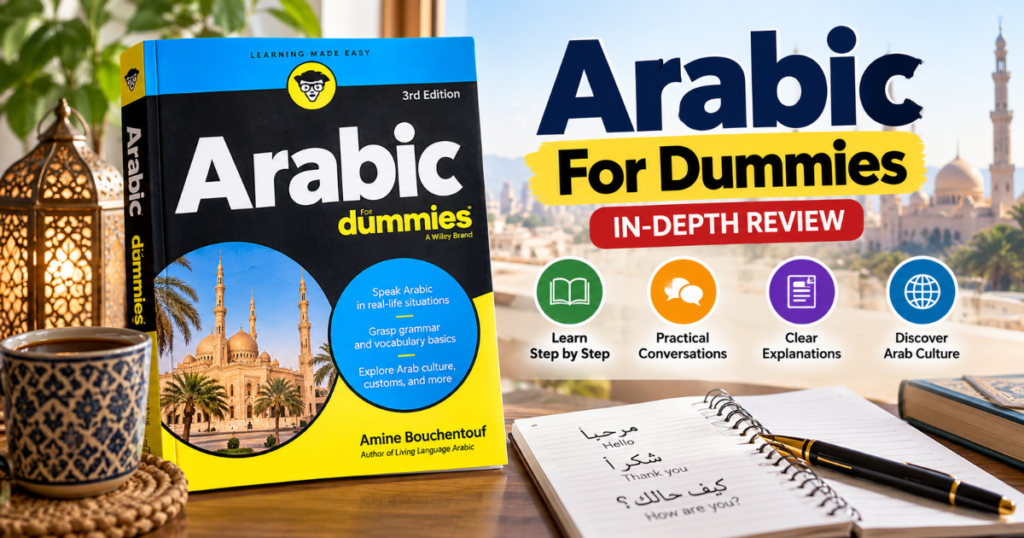
Table of Contents 58 sections
Is Arabic For Dummies a Good Book?
Arabic For Dummies is a practical starting point for English-speaking adults who want to explore Arabic without feeling overwhelmed by unfamiliar letters, grammar rules, and pronunciation. Written by Amine Bouchentouf, a native Arabic speaker from Morocco, the third edition introduces Modern Standard Arabic through useful vocabulary, everyday conversations, grammar explanations, cultural guidance, and reference materials. Instead of expecting beginners to master everything immediately, the book gives them a structured way to start building their knowledge. Its coverage of greetings, introductions, shopping, transportation, food, directions, and other everyday situations makes it particularly appealing to travelers, curious learners, students, and people who want to communicate more confidently with Arabic speakers.
Is Arabic For Dummies worth buying? For many beginners, yes. Its greatest strength is the combination of accessible explanations and practical language instruction. The book can help you understand the foundations of Arabic, recognize common expressions, and develop a more organized approach to studying. However, it is important to understand what you are buying: the third edition focuses on Modern Standard Arabic, not specifically Moroccan Darija, Egyptian Arabic, or another regional dialect. It also works best when you combine reading with listening, speaking, and regular practice. If you want a beginner-friendly textbook that gives you a useful foundation and a reference you can revisit, Arabic For Dummies deserves a place on your shortlist.
What Is Arabic For Dummies?
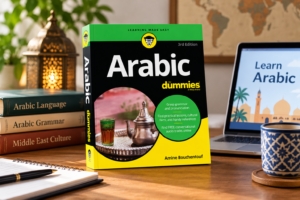
Arabic For Dummies is a language-learning book designed to help English speakers begin learning Arabic through straightforward explanations and practical examples. The third edition was published in 2018 by John Wiley & Sons under the For Dummies brand. It contains 384 pages and is available in paperback and digital editions, although availability and pricing depend on the retailer.
The book aims to make Arabic more approachable by organizing essential language concepts into manageable lessons. Rather than treating Arabic as a collection of complicated rules, it introduces the writing system, vocabulary, grammar, pronunciation, and common communication situations in a format intended for independent learners.
This approach matters because many Americans begin learning Arabic with enthusiasm but struggle to choose their first resource. Some books concentrate heavily on grammar, while others teach isolated phrases without explaining how the language works. Arabic For Dummies attempts to bridge that gap by introducing useful expressions alongside the structures that help learners understand and create their own sentences.
According to the publisher, the third edition includes revised content, a redesigned learning structure, expanded treatment of grammar and verb conjugations, and access to conversational audio tracks online. Those features make it worth considering if you want a book that combines foundational instruction with opportunities to practice listening.
You can review the publisher’s description and edition details on the official Wiley product page.
Who Wrote Arabic For Dummies?

Amine Bouchentouf is the author of Arabic For Dummies. He is a native Arabic speaker from Morocco and has experience developing and teaching Arabic courses. His professional background includes helping establish a year-round Arabic department at Middlebury College in Vermont and teaching through the ABC Language Exchange Program in New York.
That background is relevant to English-speaking learners because an effective introductory language resource needs to anticipate the difficulties students encounter when moving from English into Arabic.
Arabic uses a different writing system, has sounds that do not exist in standard American English, and follows grammatical patterns that can feel unfamiliar at first. A resource written by someone who understands Arabic and has experience teaching it to English speakers can help make these differences more approachable.
Of course, no textbook replaces an experienced teacher or regular interaction with native speakers. Nevertheless, the author’s background gives readers a useful reason to consider this book when choosing a beginner-level resource.
What Does Arabic For Dummies Teach?
One of the main reasons to consider Arabic For Dummies is its broad coverage of introductory language skills. The book is not limited to memorizing greetings or translating a list of English words. Instead, it introduces several connected elements of Arabic learning.
1. The Arabic Alphabet and Writing System
For many American beginners, the Arabic alphabet represents the first major challenge. English uses a Latin-based writing system, whereas Arabic uses a different script with letters that change shape depending on their position in a word.
Arabic also reads from right to left. Beginners must become comfortable recognizing the letters, connecting them, and distinguishing between similar-looking forms. In addition, short vowels are often omitted from ordinary written Arabic, which means learners gradually need to recognize words from their spelling patterns and context.
Arabic For Dummies introduces the foundations of the writing system so that beginners can start becoming familiar with Arabic script.
This is valuable because learning Arabic through English transliteration alone can create long-term problems. Transliteration can help you begin pronouncing words, but it does not teach you to read Arabic independently.
For example, a beginner might initially memorize an Arabic greeting using English letters. That can help with pronunciation, but recognizing the same greeting in Arabic script opens the door to reading signs, menus, messages, and learning materials.
My recommendation: Treat the alphabet section as the beginning of a continuing practice routine. Spend a little time recognizing letters, reading short words, and writing examples by hand. You do not need perfect handwriting before moving forward, but consistent exposure to Arabic script will make later lessons easier.
2. Essential Arabic Vocabulary
Vocabulary is another important part of the learning process. You need useful words before you can understand conversations or express basic needs.
Arabic For Dummies introduces vocabulary related to practical communication, including greetings, introductions, food, transportation, shopping, directions, and money.
This organization is helpful because it connects new words to situations in which learners might actually use them. A person preparing for a trip to an Arabic-speaking country, for example, can focus on expressions associated with restaurants, hotels, transportation, and asking for assistance.
Similarly, someone with Arabic-speaking colleagues or neighbors can begin building a vocabulary for introductions and everyday interaction.
However, memorizing a translation is only the first step. You also need to recognize the word when someone says it, understand how it fits into a sentence, and recall it without looking at the page.
A practical strategy is to select five to ten useful words from a lesson and review them throughout the week. Write each Arabic word, note its meaning, and create a simple example. Then return to the same vocabulary after a day or two.
By combining the book’s explanations with active recall and repeated practice, you can turn vocabulary lists into language you can actually use.
3. Basic Arabic Grammar
Arabic grammar may seem intimidating to beginners, especially those who have never studied a language beyond English. Nouns, adjectives, pronouns, sentence structure, and verb forms can all require a different way of thinking.
Arabic For Dummies introduces grammatical concepts in an accessible format. The third edition also features expanded coverage of grammar and verb conjugations, according to the publisher.
This matters because useful communication requires more than knowing individual words. You need to understand how those words work together.
For example, recognizing a noun is helpful, but forming a sentence requires you to understand the relationship between that noun and the other words around it. Likewise, knowing a verb’s basic meaning does not automatically teach you how its form changes with the subject or tense.
The book’s grammar explanations can help you begin noticing these patterns without treating every sentence as something you must memorize separately.
Still, beginners should avoid trying to learn every grammatical detail at once. Start with the structures that support your immediate goals, such as introducing yourself, asking simple questions, and describing familiar people or objects.
After that, revisit more challenging material as your vocabulary grows.
The real advantage of a structured textbook is that you can return to an explanation whenever you encounter a confusing sentence. Rather than relying entirely on memory, you have a reference that supports steady progress.
4. Pronunciation and Listening Practice
Arabic pronunciation deserves special attention because some Arabic sounds do not have direct equivalents in American English.
Learners may need to practice distinguishing similar consonants, producing unfamiliar sounds, and recognizing the difference between a written word and its pronunciation. Listening also helps you identify word boundaries and become more comfortable with the rhythm of Arabic speech.
The third edition advertises access to conversational audio tracks online. These recordings can complement the written explanations by allowing you to hear examples rather than relying only on how a word looks on the page.
This is an important advantage for self-study. You can read a phrase, listen to the corresponding audio when available, repeat it aloud, and compare your pronunciation with the model.
However, audio practice works best when it becomes an active exercise rather than something you play in the background.
Try this simple routine:
- Read a short phrase and identify its meaning.
- Listen to the corresponding recording, if available.
- Repeat the phrase aloud several times.
- Practice saying it without looking at the English translation.
- Return to the phrase the next day.
You can also record yourself and compare your pronunciation with the model. Although this method will not identify every error, it helps you become more aware of your progress.
Before purchasing, check the edition and format carefully to confirm how its supplementary audio is accessed. Digital access arrangements can differ, and you should not assume that every older physical copy includes a separate CD or that every digital edition contains identical supplementary materials.
5. Everyday Conversations
A major strength of Arabic For Dummies is its emphasis on useful communication situations.
The publisher describes material related to introducing yourself, exchanging greetings, using appropriate etiquette, making small talk, arranging transportation, ordering food and drinks, asking for directions, shopping, enjoying recreational activities, and dealing with emergencies.
These topics are particularly relevant to American learners who want to use Arabic outside a classroom.
Imagine preparing for your first trip to Morocco, Jordan, Egypt, or another Arabic-speaking destination. You may want to understand a basic greeting, ask where something is, order a meal, or communicate a simple request.
A textbook that organizes expressions around these situations can help you study with a purpose instead of memorizing unrelated vocabulary.
The same principle applies to personal and professional relationships. If you work with Arabic speakers or have friends who speak the language, learning introductions and everyday expressions can help you start conversations and demonstrate genuine interest.
Nevertheless, the book’s practical orientation should not be confused with fluency. Reading a dialogue and understanding its meaning are different from responding naturally to an unexpected question.
Use the dialogues as starting points. Change the names, places, foods, and other details. Practice the same structure with several different examples. This encourages you to produce your own sentences rather than depend on a memorized script.
6. Cultural Context and Etiquette
Language learning becomes more meaningful when it includes cultural awareness.
Arabic is used across a wide range of countries and communities. Although speakers share important linguistic traditions, customs, accents, and everyday expressions can differ significantly between regions.
Arabic For Dummies incorporates cultural information alongside language instruction. That context can help beginners understand why certain expressions matter and how to approach interactions respectfully.
For American travelers and professionals, this can be particularly useful. Knowing a greeting is valuable, but understanding when and how to use it can make communication feel more natural.
Cultural guidance can also help learners avoid treating the Arab world as a single, uniform culture. Customs vary, and it is always worth learning about the particular country or community you intend to visit or engage with.
Remember that cultural notes in any textbook provide a starting point, not a complete description of every Arabic-speaking society. Approach them with curiosity, and remain open to regional differences.
For beginners, this combination of vocabulary, communication, and cultural context makes the learning process more relevant to real life.
The Biggest Advantage: A Structured Starting Point for Beginners
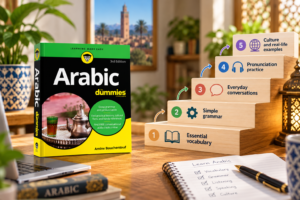
Many people begin learning Arabic with scattered online resources. They watch a video about the alphabet, save a list of common phrases, read an article about grammar, and then jump to a pronunciation tutorial.
These resources can be helpful. However, without a clear sequence, learners may struggle to understand what to study next or how different concepts connect.
Arabic For Dummies offers a more organized starting point. You can use it as a central reference while supplementing it with audio, conversation practice, and other materials.
This structure is especially useful for adults in the United States who are learning Arabic around a full-time job, family responsibilities, college classes, or travel plans.
Instead of creating a complete curriculum from scratch, you can follow the book, set small goals, and revisit the sections that need more attention.
The book also gives learners a reference they can return to after completing an initial lesson. If you forget a grammatical rule or need to review an expression, you can consult the relevant material instead of starting your research all over again.
That convenience can make independent study easier to maintain.
Of course, the book will not automatically create a study habit. You still need to decide when to study, how to review, and how to measure your progress. Yet a structured resource can reduce the friction involved in getting started.
Who Should Buy Arabic For Dummies?
Arabic For Dummies is likely to appeal to several types of learners, although its suitability depends on your goals.
Absolute Beginners
If you have never studied Arabic, this book can provide a starting point for understanding the script, common vocabulary, basic grammar, and practical expressions.
You do not need previous experience with Arabic grammar to begin. However, you should be willing to practice regularly and accept that some concepts will take time to understand.
Beginners who prefer clear explanations and a broad introduction may find this format particularly useful.
American Travelers
Travelers who want to learn basic Arabic before visiting an Arabic-speaking country may appreciate the book’s coverage of everyday situations.
You can use the relevant material to prepare for greetings, restaurants, transportation, shopping, and asking for directions.
However, consider your destination before deciding whether this is your only resource. The book focuses on Modern Standard Arabic, while everyday conversation often relies on local dialects.
For travel to Morocco, for instance, adding a dedicated Moroccan Darija resource will be particularly valuable.
College Students
Students taking an introductory Arabic course may use Arabic For Dummies as a supplementary reference.
Its accessible explanations can help reinforce concepts introduced in class, while its broader coverage may provide additional context for independent study.
Nevertheless, students should follow their instructor’s curriculum when preparing for assignments and examinations. A general introductory book may not match the vocabulary, terminology, or sequence of every university course.
Professionals and Curious Learners
Arabic can be relevant to people working in international business, education, journalism, public service, research, and other fields that involve communication across cultures.
Arabic For Dummies offers a way to begin exploring the language without immediately committing to an intensive academic program.
It can also appeal to people learning Arabic because of personal relationships, family connections, cultural interests, or a desire to learn another language.
The most important factor is having realistic expectations. A beginner’s book can build a foundation, but professional-level proficiency requires substantially more study and practice.
Independent Learners Who Like Books
Some learners prefer a physical book because it lets them highlight examples, write notes, and study without switching constantly between apps.
If you enjoy working through printed material at your own pace, the paperback format may be appealing.
You can also use the book alongside flashcards, audio resources, a notebook, and occasional lessons with a tutor.
This combination provides structure while giving you several ways to engage with the language.
Who Might Want a Different Arabic Learning Resource?
A positive review should also explain where a product may not fit.
Learners Focused on Moroccan Darija
If your primary goal is to speak Moroccan Arabic, Arabic For Dummies should not be your only learning resource.
Modern Standard Arabic and Moroccan Darija serve different purposes. Modern Standard Arabic is important in formal communication, education, writing, and many media contexts. Moroccan Darija is widely used in everyday conversations in Morocco.
The two are related, but they are not interchangeable in every situation.
Someone planning to live in Casablanca, Tangier, or Marrakech may find that local conversational skills are essential for daily interaction. In that case, supplement this book with a Moroccan Darija course, recordings of native speakers, and opportunities to practice real conversations.
Learners Who Want Immediate Conversational Fluency
No single textbook can make you fluent simply by completing its pages.
You must learn to understand speech at different speeds, retrieve words without hesitation, respond to questions, and adjust your language to unfamiliar situations.
Arabic For Dummies can help establish the foundations, but you will need additional speaking and listening practice to develop these skills.
If conversation is your main goal, consider pairing the book with online tutoring, language exchanges, or structured speaking sessions.
Learners Who Prefer a Fully Interactive App
Some people learn best through short digital exercises, automated reminders, gamified practice, and immediate feedback.
A printed textbook may feel less engaging if you strongly prefer this type of experience.
That does not mean the book lacks value. Rather, it may work better as a reference alongside an app than as your only learning tool.
Before buying, think about whether you enjoy reading explanations and practicing independently. Choosing a resource that matches your learning habits can make consistency easier.
Learners Looking for an Advanced Academic Textbook
Arabic For Dummies is designed as an accessible introductory resource. It should not be treated as a complete advanced grammar reference or a substitute for specialized university materials.
Students who already read Arabic comfortably and want advanced syntax, classical Arabic analysis, or specialized linguistic study will probably need more targeted resources.
For those learners, the book’s main value may be limited to reviewing foundational concepts.
Pros and Cons of Arabic For Dummies
Every learning resource involves trade-offs. Here is a balanced assessment of the book’s main strengths and limitations.
Pros
1. Beginner-friendly explanations
The book aims to make Arabic approachable for English speakers. Its explanatory format can help learners understand unfamiliar concepts instead of simply memorizing translations.
2. Broad coverage of essential skills
The material brings together script, vocabulary, grammar, pronunciation, and practical communication. This makes it a useful starting point for learners who want an overview rather than a phrasebook alone.
3. Practical everyday topics
Greetings, introductions, food, transportation, shopping, and directions are useful topics for travelers and people beginning to interact with Arabic speakers.
4. Grammar and verb references
The third edition includes expanded treatment of grammar and verb conjugations. These references can help learners revisit important patterns as their knowledge develops.
5. Supplementary conversational audio
The publisher advertises access to conversational audio tracks online. When accessible, these recordings can support listening and pronunciation practice.
6. Cultural context
The inclusion of cultural information gives readers more context for using language appropriately and understanding communication beyond literal translation.
7. Flexible self-study
You can study at your own pace, review difficult sections, and return to earlier lessons whenever necessary.
8. Useful as a supplementary resource
Even if you attend classes or use an app, the book can serve as a reference for grammar, vocabulary, and everyday expressions.
Cons
1. Modern Standard Arabic is not the same as every spoken dialect
The book does not replace a dedicated course in Moroccan Darija, Egyptian Arabic, Levantine Arabic, or another regional variety.
2. Self-study requires discipline
The book cannot provide the accountability, personalized corrections, or spontaneous interaction of a live teacher.
3. Reading alone will not develop conversational fluency
Learners still need active listening, speaking, and repeated practice.
4. Some learners may prefer a more interactive format
People who rely heavily on apps, video lessons, or game-like activities may want to combine the book with digital tools.
5. Supplementary materials should be checked before purchase
Availability and access instructions may vary by format or edition. Check the current product details rather than assuming every copy includes the same materials.
Overall, these limitations do not undermine the book’s usefulness as an introductory resource. They simply help clarify how to get the most value from it.
How to Get the Most Out of Arabic For Dummies
Buying a language book is easy. Turning it into a regular learning habit takes more planning.
The good news is that you do not need to study for several hours every day to make progress. A consistent routine with clear goals can be more sustainable than occasional marathon sessions.
Here is a practical approach for using Arabic For Dummies.
Step 1: Set a Clear Learning Goal
Before opening the book, decide why you want to learn Arabic.
Are you preparing for travel? Do you want to communicate with Arabic-speaking friends? Are you studying the language for academic or professional reasons? Or are you simply interested in learning something new?
Your answer should shape the way you use the book.
A traveler may prioritize greetings, food, transportation, and directions. A student may focus more heavily on grammar and reading. Someone interested in Moroccan culture may use the book for foundational knowledge while adding Darija lessons.
A clear goal helps you decide what to practice first.
Step 2: Establish a Realistic Weekly Schedule
Choose a schedule that fits your life.
For example, you might study for 20 to 30 minutes on five days each week. During each session, focus on a small amount of new material and review what you learned previously.
If you have more time, you can extend your sessions. If your schedule becomes busy, shorter sessions can help you maintain the habit.
The important point is consistency, not speed.
Step 3: Practice Reading Arabic Script
Do not rely exclusively on English transliteration.
Whenever you encounter a new Arabic word, look at its Arabic spelling and try to recognize the letters. Write it by hand if that helps you remember it.
At first, reading may feel slow. That is normal. As you become more familiar with the alphabet and common letter combinations, recognition should become easier.
You can also create a small notebook of useful words, grouped by topic.
Step 4: Listen and Repeat
When a lesson has corresponding audio, listen to it and repeat the examples aloud.
Focus on the complete phrase rather than isolating every sound. Pay attention to consonants, vowel length where relevant, rhythm, and stress.
Repeat the same material across several days instead of trying to perfect it in a single session.
Step 5: Turn Examples Into Your Own Sentences
A textbook example becomes more useful when you adapt it.
Change the names, places, objects, or other details in a sentence. Practice asking and answering simple questions. Use the vocabulary to describe your own life.
This method helps you move from recognizing a phrase to producing language independently.
Step 6: Review Instead of Constantly Moving Forward
It is tempting to keep turning pages because progress feels satisfying. However, forgetting is a normal part of learning a language.
Review previous vocabulary and grammar regularly. Use flashcards, short written exercises, or brief spoken summaries to test what you remember without looking at the answers.
Revisiting material strengthens recall and reveals which concepts need additional attention.
Step 7: Add Real Conversation Practice
Once you have learned some useful expressions, practice using them with another person.
You might work with an Arabic tutor, join a language exchange, or arrange a short conversation with someone who speaks Arabic.
Ask for corrections, but do not expect every sentence to be perfect. Your goal at the beginning is to communicate, learn from mistakes, and become more comfortable using the language.
Step 8: Measure Progress by What You Can Do
Instead of counting only the chapters you finish, measure progress through practical tasks.
Can you introduce yourself? Can you recognize a few common words when listening? Can you read a short phrase? Can you ask a basic question without checking your notes?
These are useful indicators that your study is translating into real skills.
With this approach, Arabic For Dummies becomes more than a book you read. It becomes the foundation of a repeatable learning routine.
Arabic For Dummies review vs. Other Ways to Learn Arabic
How does Arabic For Dummies compare with other common learning options?
The answer depends on what you want from your study time.
Textbooks vs. Language Learning Apps
Apps are convenient because they often offer short exercises, reminders, and quick opportunities to review vocabulary.
However, some learners find that they need more detailed explanations of grammar and writing. A textbook can provide a more continuous reference, while an app can support repetition and habit-building.
Rather than choosing one exclusively, many beginners can benefit from using both.
Use Arabic For Dummies to understand a concept, then reinforce it with digital exercises or flashcards.
Textbooks vs. Online Videos
Online videos can demonstrate pronunciation, facial movements, handwriting, and real conversational examples.
They also make it easy to explore different teachers and regional accents.
However, online content varies in quality and may not follow a coherent learning sequence. A textbook can provide structure, while videos can help you hear and see how Arabic works.
Choose videos that complement the material you are studying rather than jumping between unrelated lessons.
Textbooks vs. Private Tutors
A tutor can adapt lessons to your goals, identify pronunciation problems, answer questions, and give you immediate feedback.
A textbook cannot offer the same level of personalization.
On the other hand, a book lets you study independently whenever you have time. It can also help you prepare questions before a lesson and review material afterward.
For learners who can afford both, combining a textbook with occasional tutoring can be an effective way to balance independent study with guided practice.
Textbooks vs. Immersion
Immersion involves engaging with Arabic through conversation, media, reading, and everyday interactions.
It can help learners connect classroom knowledge with real communication. However, complete beginners may struggle if they encounter too much unfamiliar language without support.
Arabic For Dummies can provide a foundation that makes later immersion less overwhelming.
As your skills improve, increase your exposure to authentic Arabic materials and conversations.
Is Arabic For Dummies Worth the Price?
The value of a language book depends on its price, the quality of its content, how often you use it, and whether it matches your goals.
Arabic For Dummies offers a broad introduction to Arabic within one reference. If you work through its material, revisit difficult sections, and practice consistently, it can provide value beyond a single reading.
However, prices vary between retailers and formats. Used copies may cost less than new copies, while availability and delivery charges can affect the final amount you pay.
Before ordering, compare the current Amazon price with the publisher’s listing and check the edition, format, condition, and delivery details.
Also consider the cost of any additional materials you may need. If you want to focus on Moroccan Darija, for example, you may need a separate dialect resource.
Ultimately, the best question is not whether the book is the cheapest option. It is whether it offers the kind of structure and reference material you need to begin learning effectively.
For beginners who prefer an organized textbook and practical explanations, Arabic For Dummies can be a worthwhile purchase.
Where to Buy Arabic For Dummies
If you want to check the current price, availability, and purchasing options, start with the product listing below.
Check Arabic For Dummies on Amazon
Before completing your order, confirm that the listing matches the third edition, ISBN-13 9781119475392, and the format you prefer.
Review the seller information, delivery estimate, return policy, and any details about supplementary learning materials.
If you prefer an official publisher source, you can also consult Wiley’s product information for Arabic For Dummies, 3rd Edition.
Prices and availability may change, so check the current listing before buying.
A Practical Verdict: Should You Choose Arabic For Dummies?
Arabic For Dummies is a strong candidate for English-speaking beginners who want an accessible introduction to Arabic without having to assemble their entire learning plan from scattered resources.
Its broad coverage of the writing system, vocabulary, grammar, pronunciation, practical communication, and cultural context gives learners several useful starting points. The third edition’s expanded grammar and verb coverage, together with its advertised online conversational audio, adds value for people who want to combine reading with listening practice.
Its biggest strength is that it can serve as a central reference. You can study at your own pace, revisit difficult concepts, and build a routine around practical goals.
Nevertheless, the book works best when you use it actively. Read examples aloud, practice Arabic script, review vocabulary, and find opportunities to speak with other learners or Arabic speakers. If your goal is to learn Moroccan Darija or another specific dialect, add a resource designed for that variety.
My recommendation: If you are an American beginner who wants a structured, approachable introduction to Modern Standard Arabic, Arabic For Dummies is worth considering. It offers a practical foundation, and its value increases when you combine it with regular listening, writing, and conversation practice.
If that matches your learning goals, check the current edition and price before making your decision.
View Arabic For Dummies on Amazon
FAQs About Arabic For Dummies review
1. Is Arabic For Dummies good for complete beginners?
Yes. The book is designed to introduce Arabic in an accessible format, making it a reasonable starting point for English speakers with little or no previous experience. Beginners should work through the foundational material gradually and practice consistently rather than expecting to understand everything immediately.
2. Which edition of Arabic For Dummies should I buy?
The linked Amazon product corresponds to the third edition by Amine Bouchentouf, published in 2018. Its ISBN-13 is 9781119475392. Check the product details before ordering because listings can include different formats or editions.
3. Does Arabic For Dummies teach Modern Standard Arabic?
Yes. The third edition focuses on Modern Standard Arabic. This is useful for foundational study, formal communication, reading, and many educational contexts. However, it is not a substitute for learning a regional spoken dialect when everyday conversation in a particular country is your main goal.
4. Can I learn Moroccan Darija with Arabic For Dummies?
Not by relying on this book alone. Moroccan Darija has vocabulary, pronunciation, and grammatical patterns that differ from Modern Standard Arabic in important ways. Use Arabic For Dummies to establish a foundation if appropriate, then add a dedicated Moroccan Darija course or textbook and practice with speakers of the dialect.
5. Does Arabic For Dummies include audio?
The publisher advertises access to conversational audio tracks online for the third edition. Check the current listing and the specific format you plan to purchase to confirm how the supplementary audio is accessed and whether any registration or additional steps are required.
6. How many pages does Arabic For Dummies have?
The third edition is listed as a 384-page book by the publisher. Some catalog records describe the physical text using a slightly different page count, so the exact description may depend on the catalog or format.
7. Is Arabic For Dummies suitable for self-study?
Yes. Its explanatory format and reference sections can support independent learning. For better results, establish a study schedule, review earlier lessons, listen to available audio, and practice speaking. A tutor or language exchange can provide feedback that a book alone cannot.
8. Can Arabic For Dummies help me learn to speak Arabic?
It can help you build foundational vocabulary, understand common expressions, and learn basic grammatical patterns that support communication. However, speaking ability requires active practice. Repeat dialogues aloud, adapt examples to your own life, and use the language in conversations whenever possible.
9. Is Arabic For Dummies better than a language learning app?
Neither option is automatically better for everyone. A textbook can provide organized explanations and a reference you can revisit, while apps can offer short exercises and repeated vocabulary practice. Many learners benefit from combining a textbook with an app, audio materials, and conversation practice.
10. Is Arabic For Dummies worth buying in 2026?
It can be, particularly if you want a structured introduction to Modern Standard Arabic and prefer learning through a book. Although the third edition was published in 2018, its foundational language-learning material may still be useful. Check the current price, format, supplementary materials, and your learning goals before purchasing.
11. Can I use Arabic For Dummies while traveling in the Middle East or North Africa?
Yes, it can help you prepare for common communication situations, including greetings, directions, food, shopping, and transportation. However, Arabic varies across regions. Consider adding a resource for the dialect spoken at your destination, especially if you are visiting Morocco, Egypt, or the Levant.
12. Who is the author of Arabic For Dummies?
Amine Bouchentouf is the author. He is a native Arabic speaker from Morocco with experience teaching Arabic and developing language courses, including work associated with Middlebury College and the ABC Language Exchange Program in New York.
13. What should I study alongside Arabic For Dummies?
Start with the Arabic alphabet, basic vocabulary, and pronunciation. Then add regular listening practice, flashcards, simple writing exercises, and conversation. If you have a specific destination or communication goal, choose additional resources that match the relevant dialect and situations.
14. Is the paperback or digital edition better?
The paperback may appeal to learners who like writing notes, highlighting examples, and studying away from screens. A digital edition may be more convenient for travel and quick searches. Compare the available formats and verify whether supplementary audio and other resources are accessible in the version you select.
15. Where can I buy Arabic For Dummies?
You can check the Amazon product listing linked in this review or consult the publisher’s website. Compare the edition, format, seller, price, delivery details, and availability of supplementary resources before ordering.
Affiliate disclosure: This article may contain affiliate links. If you purchase through a qualifying link, the publisher of this article may earn a commission at no additional cost to you. As an Amazon Associate, the site owner may earn from qualifying purchases if enrolled in the Amazon Associates program.
Editorial note: This review is based on the publisher’s product description, bibliographic information, and an assessment of the book’s intended use. It does not claim a personal hands-on test or independent verification of current Amazon customer ratings.
Still deciding?
Overall score 9 / 10
As an Amazon Associate I earn from qualifying purchases.