Arabic Verb Forms: The 10 Patterns Explained With Charts
As an Amazon Associate I earn from qualifying purchases.
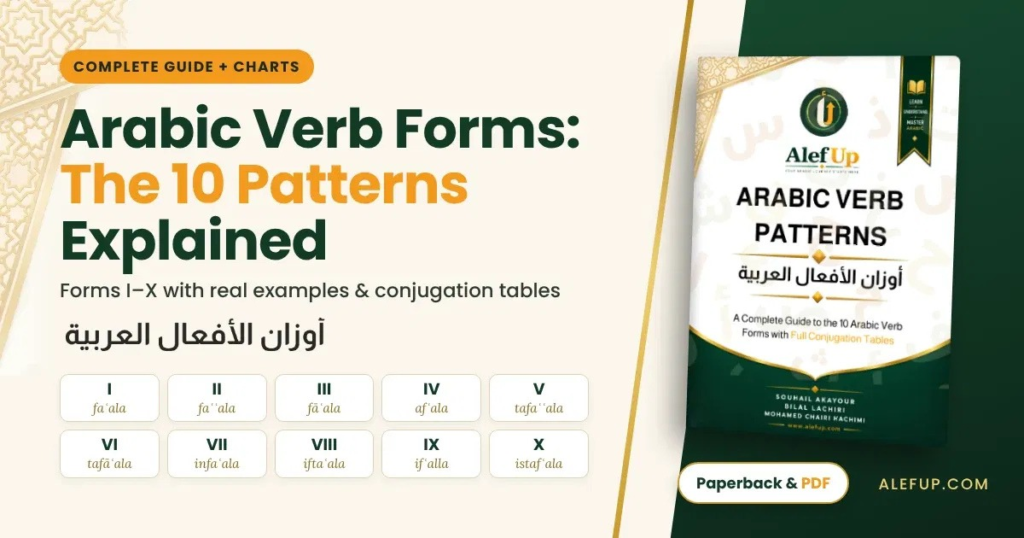
Table of Contents 34 sections
Arabic verb forms are the ten patterns (Forms I–X) that Arabic uses to turn a single three-letter root into a whole family of related verbs. Once you can recognize these patterns, you stop memorizing verbs one by one. Instead, you start seeing the system behind the language, and you can often guess the meaning of a verb you have never met before.
In this guide, we walk you through all ten forms with clear charts, real example verbs, and simple English explanations. We also show you what is inside Arabic Verb Patterns, the reference book we wrote for English-speaking learners, so you can decide whether it belongs on your desk. Our verdict is simple: if you want every pattern and every conjugation on one clean page, this is the shortcut we wish we had when we started teaching.
The Book at a Glance
- Title: Arabic Verb Patterns: A Complete Guide to the 10 Arabic Verb Forms with Full Conjugation Tables
- Authors: Souhail Akayour, Bilal Lachiri, Mohamed Chairi Hachimi
- Format: Paperback, large A4 size, full color
- Length: 24 pages of focused reference material
- Language: English explanations, fully vowelized Arabic
- Covers: Forms I–X, all 13 pronouns, past, present, future, imperative, verbal noun and both participles
- Best for: beginner and intermediate learners, self-learners, students of Modern Standard and Quranic Arabic, teachers
What Are Arabic Verb Forms?
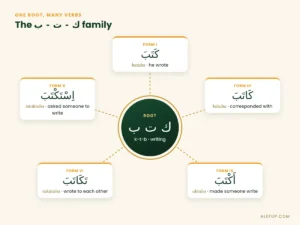
Arabic builds most of its vocabulary from roots. A root is usually a set of three consonants that carries a general idea. For example, the root ك – ت – ب (k-t-b) is connected to writing.
On its own, a root is not a word. It becomes a word only when you place it inside a pattern. The pattern adds vowels, and sometimes extra letters, around the root letters.
That is exactly what the Arabic verb forms do. Each form is a fixed template. When you pour a root into a template, you get a real verb, and each template tends to add a specific shade of meaning.
Take k-t-b again. Watch how the core idea of writing survives every change:
- كَتَبَ (kataba) – he wrote (Form I)
- كَاتَبَ (kātaba) – he corresponded with someone (Form III)
- أَكْتَبَ (aktaba) – he made someone write (Form IV)
- تَكَاتَبَ (takātaba) – they wrote to each other (Form VI)
- اِسْتَكْتَبَ (istaktaba) – he asked someone to write (Form X)
Five different verbs, one shared idea. This is why learners who understand the forms grow their vocabulary so much faster. Every new root you learn can unlock several verbs at once.
Arabic grammarians call these templates al-awzān (الأوزان), which literally means “the weights” or “the measures.” In Western textbooks, you will see them labeled with Roman numerals, from Form I to Form X.
How to Read the Pattern Model فَعَلَ
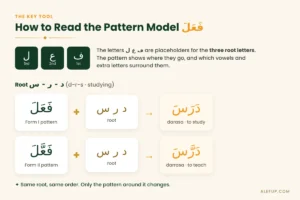
Before we look at the ten forms, you need one tool. Arabic grammarians use the root ف – ع – ل (f-ʿ-l) as a universal placeholder.
- ف stands for the first root letter.
- ع stands for the second root letter.
- ل stands for the third root letter.
So when you see a pattern written as فَعَّلَ (faʿʿala), it is not a verb to memorize. It is a map. It tells you where the root letters go and which vowels and extra letters surround them.
Let’s try it with the root د – ر – س (d-r-s), which is connected to studying:
- فَعَلَ + d-r-s = دَرَسَ (darasa) – to study
- فَعَّلَ + d-r-s = دَرَّسَ (darrasa) – to teach
Notice what happened. The root letters stayed in the same order. Only the pattern around them changed. In Form II, the middle letter is doubled, and that small change turns “to study” into “to teach.”
Here is one more example. Form III follows the model فَاعَلَ (fāʿala). Place the root ش – ر – ك (sh-r-k), connected to sharing, into it, and you get شَارَكَ (shāraka), “to participate.”
The long ا after the first letter is not part of the root. It belongs to the pattern. Once you learn to spot these added letters, you can strip any verb back to its root in seconds.
The 10 Arabic Verb Forms at a Glance
The chart below gives you the big picture. For each form, you see the past tense, the present tense, the verbal noun (maṣdar), the meaning the form usually adds, and one real example.
| Form | Past | Present | Verbal noun | Usual meaning | Example |
|---|---|---|---|---|---|
| I | فَعَل | يَفْعُلُ / يَفْعِلُ / يَفْعَلُ | varies | basic meaning | كَتَبَ to write |
| II | فَعَّلَ | يُفَعِّلُ | تَفْعِيل | causing, intensity | دَرَّسَ to teach |
| III | فَاعَلَ | يُفَاعِلُ | مُفَاعَلَة / فِعَال | doing with someone | شَارَكَ to participate |
| IV | أَفْعَلَ | يُفْعِلُ | إِفْعَال | making something happen | أَخْرَجَ to take out |
| V | تَفَعَّلَ | يَتَفَعَّلُ | تَفَعُّل | reflexive of Form II | تَعَلَّمَ to learn |
| VI | تَفَاعَلَ | يَتَفَاعَلُ | تَفَاعُل | doing to each other | تَعَاوَنَ to cooperate |
| VII | اِنْفَعَلَ | يَنْفَعِلُ | اِنْفِعَال | passive-like, “get done” | اِنْكَسَرَ to break |
| VIII | اِفْتَعَلَ | يَفْتَعِلُ | اِفْتِعَال | reflexive, “for oneself” | اِجْتَمَعَ to meet |
| IX | اِفْعَلَّ | يَفْعَلُّ | اِفْعِلَال | colors, physical traits | اِحْمَرَّ to turn red |
| X | اِسْتَفْعَلَ | يَسْتَفْعِلُ | اِسْتِفْعَال | seeking, asking for | اِسْتَخْدَمَ to use |
Keep one rule in mind. The meanings in this chart are tendencies, not laws. They help you make smart guesses, but every verb still has its own dictionary meaning. Over time, your guesses get better and faster.
In Arabic Verb Patterns, this same overview appears as a single full-page chart that also shows the future, the imperative, the active participle and the passive participle for every form. Many readers print or photograph that page and keep it next to their textbook.
Each Arabic Verb Form Explained
Now let’s go form by form. For each one, you get the pattern, the meaning it usually adds, a real example, and a quick tip that helps you recognize it in a text.
Form I – فَعَلَ (faʿala): The Base Verb
Form I is the simplest form. It contains only the three root letters plus vowels, with nothing added. It carries the basic meaning of the root.
However, Form I has a twist. Its vowels are not fixed. In the past tense, the middle letter can take a, i or u. In the present tense, the middle vowel also varies. For example:
- كَتَبَ – يَكْتُبُ (kataba – yaktubu) – to write
- جَلَسَ – يَجْلِسُ (jalasa – yajlisu) – to sit
- فَتَحَ – يَفْتَحُ (fataḥa – yaftaḥu) – to open
- فَهِمَ – يَفْهَمُ (fahima – yafhamu) – to understand
- كَبُرَ – يَكْبُرُ (kabura – yakburu) – to grow big
The verbal noun of Form I is also unpredictable. كَتَبَ gives كِتَابَة (kitāba, writing), جَلَسَ gives جُلُوس (julūs, sitting), and فَهِمَ gives فَهْم (fahm, understanding).
Tip: Learn each new Form I verb as a pair, past plus present, together with its verbal noun. The good news? Forms II to X are far more regular, so this extra effort pays off only once.
Form II – فَعَّلَ (faʿʿala): Causing and Intensifying
Form II doubles the middle root letter. You will see this as a shadda (ّ) on the second letter.
This form often makes a verb causative, meaning someone causes another person to do something. It can also make an action more intense or repeated.
- دَرَسَ (to study) → دَرَّسَ (darrasa, to teach, literally “to make someone study”)
- عَلِمَ (to know) → عَلَّمَ (ʿallama, to teach, “to make someone know”)
The present tense is يُفَعِّلُ (yufaʿʿilu), and the verbal noun is always تَفْعِيل (tafʿīl). For example, تَدْرِيس (tadrīs) means “teaching.”
Here is a bonus. The active participle مُدَرِّس (mudarris) is the everyday word for “teacher.” Once you know Form II, you suddenly understand where that word comes from.
Tip: See a shadda on the middle root letter of a verb? Think Form II first.
Form III – فَاعَلَ (fāʿala): Doing Something With Someone
Form III adds a long ā after the first root letter. It often describes an action you do with or toward another person.
- شَارَكَ (shāraka) – to participate, to share with someone
- كَاتَبَ (kātaba) – to correspond with someone
- سَاعَدَ (sāʿada) – to help someone
The present tense is يُفَاعِلُ (yufāʿilu). The verbal noun usually follows مُفَاعَلَة (mufāʿala), as in مُشَارَكَة (mushāraka, participation). Some verbs also use فِعَال (fiʿāl), as in جِهَاد (jihād, striving) next to مُجَاهَدَة.
Tip: A long ā right after the first root letter is the signature of Form III.
Form IV – أَفْعَلَ (afʿala): Making Something Happen
Form IV adds a hamza with a short a at the beginning. Like Form II, it is often causative, but it tends to express simply “making something happen.”
- خَرَجَ (to go out) → أَخْرَجَ (akhraja, to take out, to bring out)
- رَسَلَ root → أَرْسَلَ (arsala, to send)
The present tense is يُفْعِلُ (yufʿilu), and the hamza disappears in it. The verbal noun is إِفْعَال (ifʿāl), as in إِخْرَاج (ikhrāj). Fun fact: the active participle مُخْرِج (mukhrij) is the Arabic word for a film director, the person who “brings out” the movie.
Tip: Do not confuse Form IV with the first-person present “I…” (أَفْعَلُ). The final vowel and the context tell them apart.
Form V – تَفَعَّلَ (tafaʿʿala): The Reflexive of Form II
Form V takes Form II and adds تَ (ta) at the front. It often turns the action back on the subject.
- عَلَّمَ (to teach) → تَعَلَّمَ (taʿallama, to learn, literally “to teach oneself”)
The present tense is يَتَفَعَّلُ (yatafaʿʿalu), and the verbal noun is تَفَعُّل (tafaʿʿul), as in تَعَلُّم (taʿallum, learning). The active participle مُتَعَلِّم (mutaʿallim) means “learner.” That is you!
Tip: ta + doubled middle letter = Form V.
Form VI – تَفَاعَلَ (tafāʿala): Doing Something to Each Other
Form VI takes Form III and adds تَ at the front. Where Form III is “doing with someone,” Form VI is usually mutual: people doing the action to each other.
- تَعَاوَنَ (taʿāwana) – to cooperate
- تَكَاتَبَ (takātaba) – to write to each other
The present tense is يَتَفَاعَلُ (yatafāʿalu), and the verbal noun is تَفَاعُل (tafāʿul). In fact, the word تَفَاعُل itself means “interaction,” which is a perfect summary of the form.
Tip: ta + long ā after the first root letter = Form VI.
Form VII – اِنْفَعَلَ (infaʿala): Getting Something Done to You
Form VII adds اِنْ (in) at the front. It often gives a passive-like meaning: something happens to the subject.
- كَسَرَ (to break something) → اِنْكَسَرَ (inkasara, to get broken, to break)
- قَطَعَ (to cut) → اِنْقَطَعَ (inqaṭaʿa, to be cut off)
The present tense is يَنْفَعِلُ (yanfaʿilu), and the verbal noun is اِنْفِعَال (infiʿāl). You will hear اِنْقِطَاع (inqiṭāʿ) every time the power or the internet cuts out!
Tip: A verb that starts with “in-” followed by three root letters is almost always Form VII.
Form VIII – اِفْتَعَلَ (iftaʿala): Doing Something for Oneself
Form VIII is a little sneaky. It adds an i at the front and a تَ after the first root letter. The meaning is often reflexive.
- جَمَعَ (to gather things) → اِجْتَمَعَ (ijtamaʿa, to gather together, to meet)
- سَمِعَ (to hear) → اِسْتَمَعَ (istamaʿa, to listen)
The present tense is يَفْتَعِلُ (yaftaʿilu), and the verbal noun is اِفْتِعَال (iftiʿāl), as in اِجْتِمَاع (ijtimāʿ, meeting). Better still, the passive participle مُجْتَمَع (mujtamaʿ) means “society,” the place where people gather.
Tip: When the first root letter is ص, ض, ط, ظ, د, ذ or ز, the added ta often changes its sound. Do not let that throw you off; the pattern is still Form VIII.
Form IX – اِفْعَلَّ (ifʿalla): Colors and Physical Traits
Form IX is the rarest form. It doubles the last root letter and is used mainly for colors and visible physical traits.
- اِحْمَرَّ (iḥmarra) – to turn red, to blush
- اِصْفَرَّ (iṣfarra) – to turn yellow, to turn pale
The present tense is يَفْعَلُّ (yafʿallu), and the verbal noun is اِفْعِلَال (ifʿilāl). Because Form IX verbs do not take a direct object, they normally have no passive participle. That is why our chart shows a dash in that column.
Tip: Spot a color word ending in a doubled letter? It is Form IX.
Form X – اِسْتَفْعَلَ (istafʿala): Seeking and Asking For
Form X adds اِسْتَ (ista) at the front. It often means seeking, requesting or considering something to be a certain way.
- اِسْتَخْدَمَ (istakhdama) – to use (originally “to seek service from”)
- اِسْتَغْفَرَ (istaghfara) – to seek forgiveness
- اِسْتَكْتَبَ (istaktaba) – to ask someone to write
The present tense is يَسْتَفْعِلُ (yastafʿilu), and the verbal noun is اِسْتِفْعَال (istifʿāl). You know at least one already: مُسْتَخْدِم (mustakhdim) is the word for “user” on every Arabic website and app.
Tip: “ista-” at the start of a verb is the clearest signal in the whole system. It is almost always Form X.
Participles: Two Free Words With Every Verb
Every form also gives you two useful nouns, and they follow the pattern just as reliably as the verbs do.
- The active participle (اسم الفاعل) names the doer: مُدَرِّس (teacher), مُتَعَلِّم (learner), مُسْتَخْدِم (user).
- The passive participle (اسم المفعول) names what the action is done to: مَكْتُوب (written, a letter), مُسْتَخْدَم (used).
In Forms II to X, both participles start with مُ (mu-). Usually, the active one has an i before the last root letter, and the passive one has an a. That single vowel is the whole difference between مُسْتَخْدِم (user) and مُسْتَخْدَم (used).
This is why vowel marks matter so much for learners, and why every Arabic form in our book is fully vowelized.
Future and Imperative in One Minute
Many learners expect Arabic to have a separate future tense. It does not. Instead, you take the present tense and add a marker in front of it.
- سَـ (sa-) attached to the verb: أَكْتُبُ (I write) → سَأَكْتُبُ (I will write)
- سَوْفَ (sawfa) placed before the verb: سَوْفَ أَكْتُبُ (I will write)
So once you know the present tense of a form, you already know its future. That is exactly how the future column works in the conjugation tables of the book.
The imperative, meanwhile, is for direct commands, so it exists only for “you.” From كَتَبَ you get اُكْتُبْ (uktub, write!) for one man, اُكْتُبِي for one woman, اُكْتُبَا for two people, اُكْتُبُوا for a group of men, and اُكْتُبْنَ for a group of women.
That is why, in a full conjugation table, the imperative column shows a dash for “I,” “he,” “she” and “they.” Nothing is missing; commands simply do not apply there.
5 Common Mistakes Learners Make With Arabic Verb Forms
1. Memorizing verbs instead of patterns. If you learn تَعَلَّمَ as a random word, you learn one verb. If you learn it as Form V of ع-ل-م, you also understand عَلَّمَ, مُعَلِّم and مُتَعَلِّم.
2. Treating meanings as strict rules. Form X often means “seeking,” but not always. Use the meanings to guess, then confirm with a dictionary.
3. Ignoring the short vowels. The difference between active and passive participles, or between Form I and Form II, often lives in a vowel or a shadda. Fully vowelized material trains your eye to see it.
4. Trying to learn all ten forms in one day. Start with the most frequent forms: I, II, IV, V, VIII and X. Then add III, VI and VII. Form IX can wait.
5. Skipping the root. Before you look up a verb, try to strip it back to its three root letters. This single habit makes Arabic dictionaries usable and turns every new word into a pattern lesson.
Inside the Book: What You Get in Arabic Verb Patterns
We designed Arabic Verb Patterns as the reference page we always wanted to hand our own students. It is not a long textbook. Instead, it is a focused, beautifully laid-out guide you can keep open next to whatever course you are following.
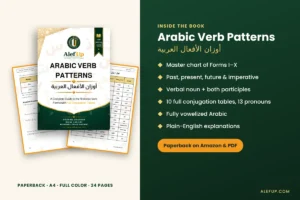
Here is exactly what is inside, in order:
- A clear preface that explains roots and patterns with the k-t-b family.
- “How to Read Arabic Verb Patterns”, which teaches the ف-ع-ل model step by step with the roots d-r-s and sh-r-k.
- One master chart of Forms I–X showing past, present, future, imperative, verbal noun, active participle and passive participle for every form.
- Important notes on the tricky parts: Form I vowel variations, Form I and III verbal nouns, and why Form IX has no passive participle.
- A personal pronouns table covering all 13 Arabic pronouns, including the dual.
- A simple explanation of the future with سَـ and سَوْفَ.
- A clear explanation of the imperative and why some cells show a dash.
- Ten full conjugation tables, one per form, across all 13 pronouns.
Every Arabic word is fully vowelized. Every explanation is in plain English. And because the book is printed in large A4 format and in full color, the tables are easy to read at a glance, even from across the desk.
What makes it different
Most Arabic grammar books spread the verb forms across dozens of chapters. As a result, learners rarely see the whole system at once. Our book does the opposite: it puts the entire system in front of you, so you can compare the forms side by side and notice the patterns for yourself.
In addition, it was written by teachers who work with English-speaking learners every week. We built it around the questions our students actually ask, such as “Why is there a dash here?” and “Where is the future tense?”
What it is not
We want you to buy the right book, so here is the honest part. Arabic Verb Patterns is a reference guide, not a workbook. It does not include exercises, and its conjugation tables use the regular model فَعَلَ rather than weak or irregular verbs.
If you need hundreds of practice drills or a deep study of weak verbs, use it alongside a full course. That is exactly how it shines: as the chart you keep coming back to while you learn everything else. Future AlefUp guides will add practice and real-life examples for each pattern.
Who Should Get This Book?
Beginners who just finished the alphabet. As soon as you can read vowelized Arabic, the verb forms become your next big step. This book gives you the map before you get lost.
Intermediate learners who feel stuck. If you know many words but still feel that verbs are random, the forms are usually the missing piece. Seeing all ten side by side often creates a real “aha” moment.
Students of Quranic Arabic. The Quran uses all of these forms constantly. Recognizing اِسْتَغْفَرَ as Form X or تَعَاوَنُوا as Form VI helps you understand verses more directly.
Self-learners. Without a teacher, you need reliable reference material. Clear tables and plain-English notes keep you from guessing.
Teachers and tutors. The master chart works perfectly as a classroom handout or a quick visual during online lessons.
How to Study the Arabic Verb Forms: A Simple 4-Week Plan
Week 1 – Learn to read the model. Master ف-ع-ل. Take five roots you already know and place each one into Forms I and II. Say the results out loud.
Week 2 – The “added letter” forms. Study Forms III, IV and X. Focus on the letters each form adds: the long ā, the initial hamza, and “ista-.”
Week 3 – The “ta” and “in” forms. Study Forms V, VI, VII and VIII. Compare V with II and VI with III, since each one builds on the other.
Week 4 – Read and hunt. Take any vowelized text, such as a short story or a few verses, and hunt for verbs. For each one, find the root, name the form and guess the meaning before checking. Finish with Form IX, the easiest to spot.
Throughout the four weeks, keep the master chart open in front of you. Repetition with a single, consistent visual is what makes the patterns stick.
Paperback or PDF: Which One Should You Choose?
Choose the paperback if you like learning on paper, writing notes in the margins, or keeping a reference on your desk. The large color format makes the tables easy to read, and it ships through Amazon.
Choose the PDF from our store if you want instant access, prefer studying on a tablet, or want to print only the pages you need. It is also the fastest option if you are outside the United States.
Either way, the content is the same. Pick the format you will actually open every day.
Your Next Step: Turn Ten Patterns Into Thousands of Words
The Arabic verb forms are one of the most powerful shortcuts in the entire language. Ten templates, applied to thousands of roots, generate a huge part of the vocabulary you will ever read or hear.
Once you learn to see them, Arabic stops looking like a list of unrelated words. Instead, it starts to look like a system. You recognize مُدَرِّس, تَعَلُّم, اِجْتِمَاع and مُسْتَخْدِم as members of families you already know.
Start today with the chart in this guide. Then, if you want every form, every tense and every pronoun on clean, fully vowelized pages that you can keep beside you, Arabic Verb Patterns is the companion we built for exactly that job.
FAQ: Arabic Verb Forms
How many Arabic verb forms are there?
Modern Standard Arabic uses ten common forms for three-letter roots, numbered I to X. A few rarer forms exist, but learners almost never need them. Four-letter roots have their own small set of patterns.
Which Arabic verb forms should I learn first?
Start with Form I, then focus on the most frequent derived forms: II, IV, V, VIII and X. Add III, VI and VII next. Form IX is rare and mostly used for colors.
Do the verb forms always have the same meaning?
No. Each form has typical meanings, such as causation in Form II or seeking in Form X, but these are tendencies. Use them to make an educated guess, then confirm the meaning in a dictionary.
What is the difference between Form II and Form IV?
Both are often causative. Form II doubles the middle root letter (فَعَّلَ), while Form IV adds a hamza at the start (أَفْعَلَ). Some roots use one, some use the other, and a few use both with different meanings.
Does Arabic have a future tense?
Not as a separate conjugation. You form the future by adding سَـ or سَوْفَ before the present-tense verb, as in سَأَكْتُبُ (I will write).
Are the verb forms the same in Quranic Arabic?
Yes. Quranic and Modern Standard Arabic share the same verb form system, which is why understanding the forms is so valuable for students of the Quran.
Is Arabic Verb Patterns suitable for complete beginners?
Yes, as long as you can read the Arabic alphabet with vowel marks. All explanations are in simple English, and every Arabic word is fully vowelized.
Does the book include exercises?
No. It is a reference guide with explanations, a master chart and full conjugation tables. It works best alongside a course or a teacher. Future AlefUp guides will add practice for each pattern.
How big is the book?
It is a 24-page, full-color paperback in large A4 format (8.27 × 11.69 inches), designed so that every table is easy to read.
Still deciding?
Overall score 9.5 / 10
As an Amazon Associate I earn from qualifying purchases.