Table of Contents 33 sections
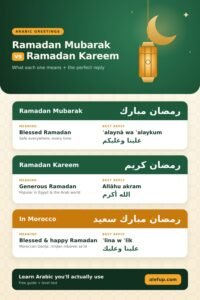
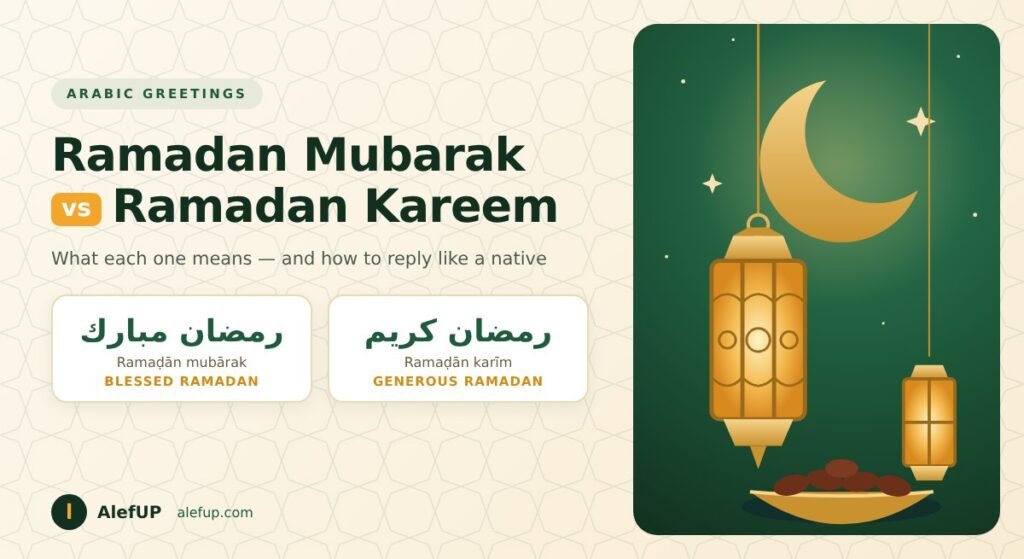
The short answer: In the Ramadan Mubarak vs Ramadan Kareem question, both greetings are correct. Ramadan Mubarak (رَمَضَانُ مُبَارَكٌ) means “Blessed Ramadan,” while Ramadan Kareem (رَمَضَانُ كَرِيمٌ) means “Generous Ramadan.” Ramadan Mubarak is the safest everyday choice, and the best reply to Ramadan Kareem is Allāhu akram (اللهُ أَكْرَمُ) – “God is more generous.”
Every year, the same question pops up in American offices, classrooms, and group chats. A Muslim coworker is about to start fasting, and you want to say something kind. However, you have seen two different greetings online, and you are not sure which one fits. Good news: you cannot really get this wrong. Still, knowing what each phrase means will make your greeting sound warm and natural instead of copied from a card. In this guide, our teachers at AlefUp break down both phrases word by word. Then, you will learn how to reply, five more greetings people actually use (including Moroccan Darija), the key Ramadan vocabulary, and the mistakes English speakers make most often. Ramadan is the ninth month of the Islamic lunar calendar, and Muslims fast from dawn to sunset throughout it. In 2027, it is expected to begin around February 8, although the exact date depends on the moon sighting in each country. So now is the perfect time to learn your greetings. If you cannot read Arabic script yet, don’t worry. Every word below comes with a transliteration and a translation. And when you are ready, our step-by-step guide on how to learn to read Arabic will help you read these phrases on your own.1. What Does Ramadan Mubarak Mean?
Ramadan Mubarak is the most common Ramadan greeting in the world. You will hear it in Cairo, Casablanca, Jakarta, and Dearborn, Michigan alike. Literally, رَمَضَانُ مُبَارَكٌ (Ramaḍānu mubārakun) means “Ramadan is blessed” or simply “Blessed Ramadan.” In everyday speech, people drop the grammar endings and say Ramaḍān mubārak.Breaking It Down Word by Word
The first word is رَمَضَان (Ramaḍān), the name of the month. Its root is connected to intense heat, which reflects how the month got its name long ago. The second word is مُبَارَك (mubārak) – blessed. It comes from the three-letter root ب-ر-ك (b-r-k), the same root as بَرَكَة (baraka) – blessing. That root system is one of the most powerful tools in Arabic. Once you spot ب-ر-ك, you start seeing it everywhere, from greetings to prayers.Teacher’s tip: In our lessons, students light up when they realize that مَبْرُوك (mabrūk) – “congratulations” – shares the same root as mubārak. Learn one root, and you get a whole family of words for free. Say mabrūk for a wedding or a new job, and mubārak for Ramadan and Eid.
When to Say Ramadan Mubarak
You can say Ramadan Mubarak in the days just before the month begins and at any point during the month. It works in person, in a text, in an email, or on a social media post. It also fits every relationship. Your boss, your neighbor, a classmate, or a close friend will all appreciate it. In short, if you remember only one phrase from this article, make it this one.2. What Does Ramadan Kareem Mean?
Ramadan Kareem is the second big greeting, and it is especially popular in Egypt and across much of the Arab world. You will also see it on banners, store windows, and greeting cards. رَمَضَانُ كَرِيمٌ (Ramaḍānu karīmun) means “Ramadan is generous” or “Generous Ramadan.” In casual speech, people say Ramaḍān karīm.The Root Behind “Kareem”
كَرِيم (karīm) comes from the root ك-ر-م (k-r-m), which carries the idea of generosity and nobility. From the same root, you get كَرَم (karam) – generosity – and أَكْرَم (akram) – more generous. You may already know this word without realizing it. Muslims call their holy book الْقُرْآنُ الْكَرِيمُ (al-Qurʾān al-Karīm) – the Noble Quran. In fact, the Quran itself describes Ramadan as the month in which it was revealed (Surah al-Baqarah 2:185).Why Some People Prefer Ramadan Mubarak
Here is the part most guides skip. Some Muslim scholars have argued that Ramadan Kareem is not the best wording. Their reasoning is simple: generosity belongs to God, and the month itself does not give anything. That is exactly why the classic reply to Ramadan Kareem is اللهُ أَكْرَمُ (Allāhu akram) – “God is more generous.” The reply gently shifts the credit from the month to God. Nevertheless, millions of Muslims use Ramadan Kareem every year with nothing but good intentions. So as a learner, you will not offend anyone with it. Our honest advice: use Ramadan Mubarak as your default. Then, if someone greets you with Ramadan Kareem, answer with Allāhu akram, and you will sound like you have been doing this for years.Ramadan Mubarak vs Ramadan Kareem: Which One Should You Use?
Now that you know both meanings, let’s put them side by side. This quick comparison answers the question in one glance.| Ramadan Mubarak | Ramadan Kareem | |
|---|---|---|
| Arabic | رَمَضَانُ مُبَارَكٌ | رَمَضَانُ كَرِيمٌ |
| Meaning | Blessed Ramadan | Generous Ramadan |
| Root | ب-ر-ك (blessing) | ك-ر-م (generosity) |
| Where it’s common | Worldwide | Egypt and much of the Arab world |
| Best reply | عَلَيْنَا وَعَلَيْكُمْ (ʿalaynā wa ʿalaykum) | اللهُ أَكْرَمُ (Allāhu akram) |
| Safe for learners? | Yes, always | Yes, with the right reply |
How to Reply to Ramadan Greetings
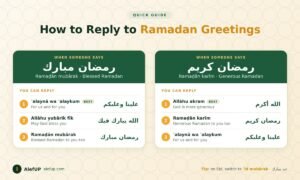
 Replying is where most learners freeze. Fortunately, you only need a handful of answers. Here are the ones our students use most:
| When someone says… | You reply | Transliteration | Meaning |
|---|---|---|---|
| رَمَضَانُ مُبَارَكٌ | رَمَضَانُ مُبَارَكٌ | Ramaḍān mubārak | Blessed Ramadan (to you too) |
| رَمَضَانُ مُبَارَكٌ | عَلَيْنَا وَعَلَيْكُمْ | ʿalaynā wa ʿalaykum | (May it be blessed) for us and for you |
| رَمَضَانُ مُبَارَكٌ | اللهُ يُبَارِكُ فِيكَ / فِيكِ | Allāhu yubārik fīk / fīki | May God bless you (to a man / a woman) |
| رَمَضَانُ كَرِيمٌ | اللهُ أَكْرَمُ | Allāhu akram | God is more generous |
Teacher’s tip: We tell our students to practice the reply, not the greeting. You usually choose when to say Ramadan Mubarak, but you never know when someone will say it to you. Say ʿalaynā wa ʿalaykum out loud five times today, and it will come out naturally when you need it.
5 More Ramadan Greetings Native Speakers Actually Use
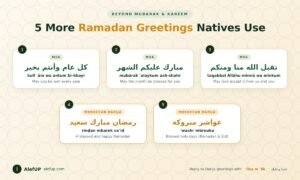 Ramadan Mubarak and Ramadan Kareem are only the beginning. Native speakers have several other phrases, and a few of them will instantly make you sound more fluent.
3. Kull ʿĀm wa Antum bi-Khayr (MSA)
كُلُّ عَامٍ وَأَنْتُمْ بِخَيْرٍ (kull ʿām wa antum bi-khayr) – “May you be well every year.” People use it for Ramadan, Eid, birthdays, and the new year. The reply is easy: وَأَنْتُمْ بِخَيْرٍ (wa antum bi-khayr) – “And you too, be well.”4. Mubārak ʿAlaykum ash-Shahr (MSA)
مُبَارَكٌ عَلَيْكُمُ الشَّهْرُ (mubārak ʿalaykum ash-shahr) – “May the month be blessed for you.” It sounds a little more formal, so it fits an email to a colleague or a message to an elder.5. Taqabbal Allāhu Minnā wa Minkum (MSA)
تَقَبَّلَ اللهُ مِنَّا وَمِنْكُمْ (taqabbal Allāhu minnā wa minkum) – “May God accept (our good deeds) from us and from you.” It is a prayer more than a greeting, and you will hear it most at the end of Ramadan and on Eid. To reply, simply say the same phrase back, or shorten it to مِنَّا وَمِنْكُمْ (minnā wa minkum).6. Rmḍan Mbarek Saʿid (Moroccan Darija)
In Morocco, you will often hear رْمْضَانْ مْبَارْكْ سْعِيدْ (rmḍan mbarek saʿid) – “A blessed and happy Ramadan.” Notice how Darija drops many short vowels, so Ramaḍān becomes rmḍan. The most natural reply is عْلِينَا وْعْلِيكْ (ʿlina w ʿlik) – “For us and for you,” or الله يْبَارْكْ فِيكْ (llah ybarek fik) – “God bless you.”7. ʿWashr Mbrouka (Moroccan Darija)
عْوَاشَرْ مْبْرُوكَة (ʿwashr mbrouka) is a uniquely Moroccan greeting for holy seasons, including Ramadan and Eid. Roughly, it means “Blessed holy days.” Again, ʿlina w ʿlik is the perfect answer.Teacher’s tip: We teach in Tangier, and nothing makes Moroccans smile faster than a foreigner saying ʿwashr mbrouka. If you are traveling to Morocco during Ramadan, learn this one before you land. Pair it with our guide to Moroccan Darija greetings, and you will handle every hello at the market or the café.
Bonus: Don’t Forget Eid Mubarak
When Ramadan ends, the greeting changes. On Eid al-Fitr, people say عِيدٌ مُبَارَكٌ (ʿĪd mubārak) – “Blessed Eid” – or عِيدٌ سَعِيدٌ (ʿĪd saʿīd) – “Happy Eid.” Planning a trip? Our Morocco travel guide helps you plan your visit, and our free Darija level test shows you how much Moroccan Arabic you already understand.Essential Ramadan Vocabulary in Arabic
Greetings open the door, but vocabulary keeps the conversation going. These are the words you will hear again and again during the month.| Arabic | Transliteration | Meaning | Example in context |
|---|---|---|---|
| رَمَضَان | Ramaḍān | Ramadan, the ninth Islamic month | رَمَضَانُ مُبَارَكٌ – Blessed Ramadan |
| صِيَام | ṣiyām | fasting | صِيَامُ رَمَضَانَ – the Ramadan fast |
| صَائِم / صَائِمَة | ṣāʾim / ṣāʾima | fasting (man / woman) | أَنَا صَائِمٌ – I am fasting |
| سُحُور | suḥūr | the pre-dawn meal | نَأْكُلُ السُّحُورَ قَبْلَ الْفَجْرِ – We eat suḥūr before dawn |
| إِفْطَار | ifṭār | the meal that breaks the fast at sunset | وَقْتُ الْإِفْطَارِ – iftar time |
| هِلَال | hilāl | crescent moon | رُؤْيَةُ الْهِلَالِ – sighting the crescent |
| تَمْر | tamr | dates (the fruit) | نُفْطِرُ عَلَى التَّمْرِ – We break the fast with dates |
| تَرَاوِيح | tarāwīḥ | special night prayers of Ramadan | صَلَاةُ التَّرَاوِيحِ – the tarāwīḥ prayer |
| لَيْلَةُ الْقَدْرِ | Laylat al-Qadr | the Night of Power | فِي الْعَشْرِ الْأَوَاخِرِ – in the last ten nights |
| زَكَاةُ الْفِطْرِ | zakāt al-fiṭr | charity given before Eid | – |
| عِيدُ الْفِطْرِ | ʿĪd al-Fiṭr | the holiday that ends Ramadan | عِيدٌ مُبَارَكٌ – Blessed Eid |
Two Moroccan Words Every Visitor Should Know
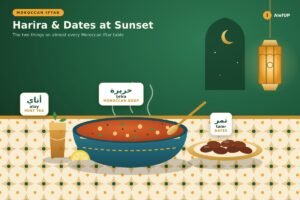
 In Moroccan Darija, the iftar meal is usually called فْطُور (fṭur). Interestingly, in Modern Standard Arabic, فَطُور (faṭūr) simply means breakfast, because both meals “break” a fast. If you want more food words, our list of Arabic vocabulary for breakfast foods is a great next step.
The second word is حْرِيرَة (ḥrira), the rich tomato, lentil, and chickpea soup that sits on almost every Moroccan iftar table. Order it once, and you will understand why Moroccans wait for it all day.
Learn the Words as a Family
Notice that ifṭār, fṭur, and ʿĪd al-Fiṭr all share the root ف-ط-ر (f-ṭ-r), which relates to breaking a fast. Just like mubārak and mabrūk, one root unlocks several words at once. That is why we always encourage learners to study vocabulary in root families rather than random lists. You remember more, and you guess new words more accurately.5 Common Mistakes English Speakers Make With Ramadan Greetings
Even well-meaning learners slip up. Fortunately, each of these mistakes is easy to fix once you know about it.Mistake 1: Saying Ramadan Mubarak on Eid
Once the month ends, Ramadan greetings are over. On Eid al-Fitr, switch to ʿĪd mubārak (عِيدٌ مُبَارَكٌ). Using the wrong one is not rude, but it does show you are not following the calendar.Mistake 2: Pronouncing the “D” Like an English D
The “d” in Ramaḍān is actually the letter ض (ḍād), a heavy, emphatic sound with no English equivalent. Press your tongue against your upper teeth, deepen your voice, and let the sound fill your mouth. Arabic is sometimes called لُغَةُ الضَّادِ (lughat aḍ-ḍād) – “the language of the ḍād” – because this letter is so distinctive. If the sound still feels strange, our book The Arabic Alphabet walks you through every letter, including ض, step by step. This is also why you will see the spelling “Ramadhan” in some countries. It reflects a different local pronunciation of the same letter, not a different word.Mistake 3: Mixing Up Mubārak and Mabrūk
Both words come from the same root, but they are not interchangeable. Mubārak means “blessed,” so it goes with Ramadan and Eid. Mabrūk means “congratulations,” so it goes with weddings, graduations, and new babies.Mistake 4: Freezing When Someone Greets You First
Many learners prepare their greeting but never prepare a reply. As a result, they answer with an awkward “Thanks!” Keep ʿalaynā wa ʿalaykum or Allāhu akram ready, and you will never be caught off guard.Mistake 5: Assuming Ramadan Starts on the Same Day Everywhere
Ramadan begins with the sighting of the new crescent moon, so the start date can differ by a day between countries and even between communities in the US. Instead of guessing, simply ask: “When does Ramadan start for you?” It is a thoughtful question, and people appreciate it.Your Ramadan Greeting Is Ready – Now Make It Your Own
So, Ramadan Mubarak vs Ramadan Kareem? Both are correct, both are kind, and both will be received with a smile. Ramadan Mubarak is your safest everyday choice, while Ramadan Kareem calls for the elegant reply Allāhu akram. Beyond that, you now have five more greetings, two of them straight from Moroccan Darija, plus the vocabulary to follow a real conversation about fasting, iftar, and Eid. That is far more than most English speakers ever learn. Most importantly, you have seen how Arabic works. One root like ب-ر-ك or ف-ط-ر unlocks a whole family of words, and that insight will speed up everything you learn next. Ready for the next step? Take our free Arabic level test – up to 35 questions, about 25 minutes, no account needed – and find out exactly where you stand. If you would rather learn with a real teacher this Ramadan, you can book a private lesson with Souhail on WhatsApp in Modern Standard Arabic, Moroccan Darija, or Quranic Arabic. Ramaḍān mubārak from all of us at AlefUp! As an Amazon Associate I earn from qualifying purchases.